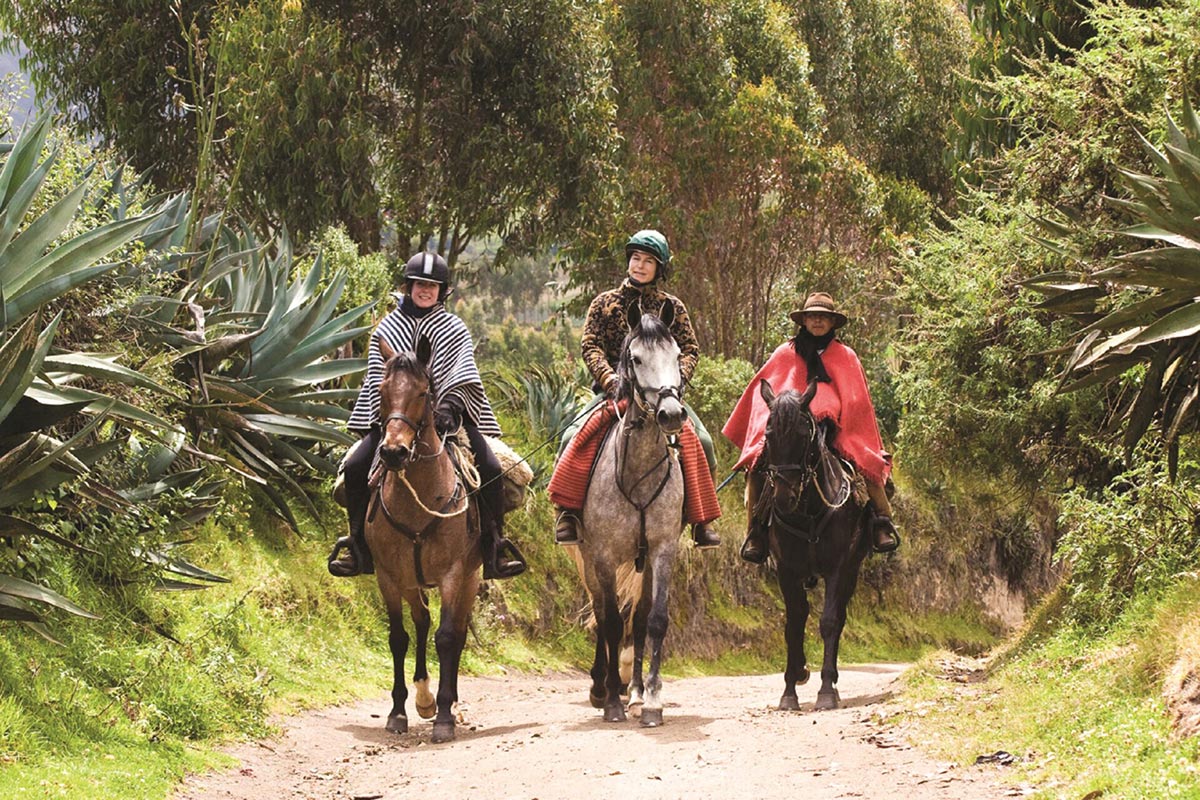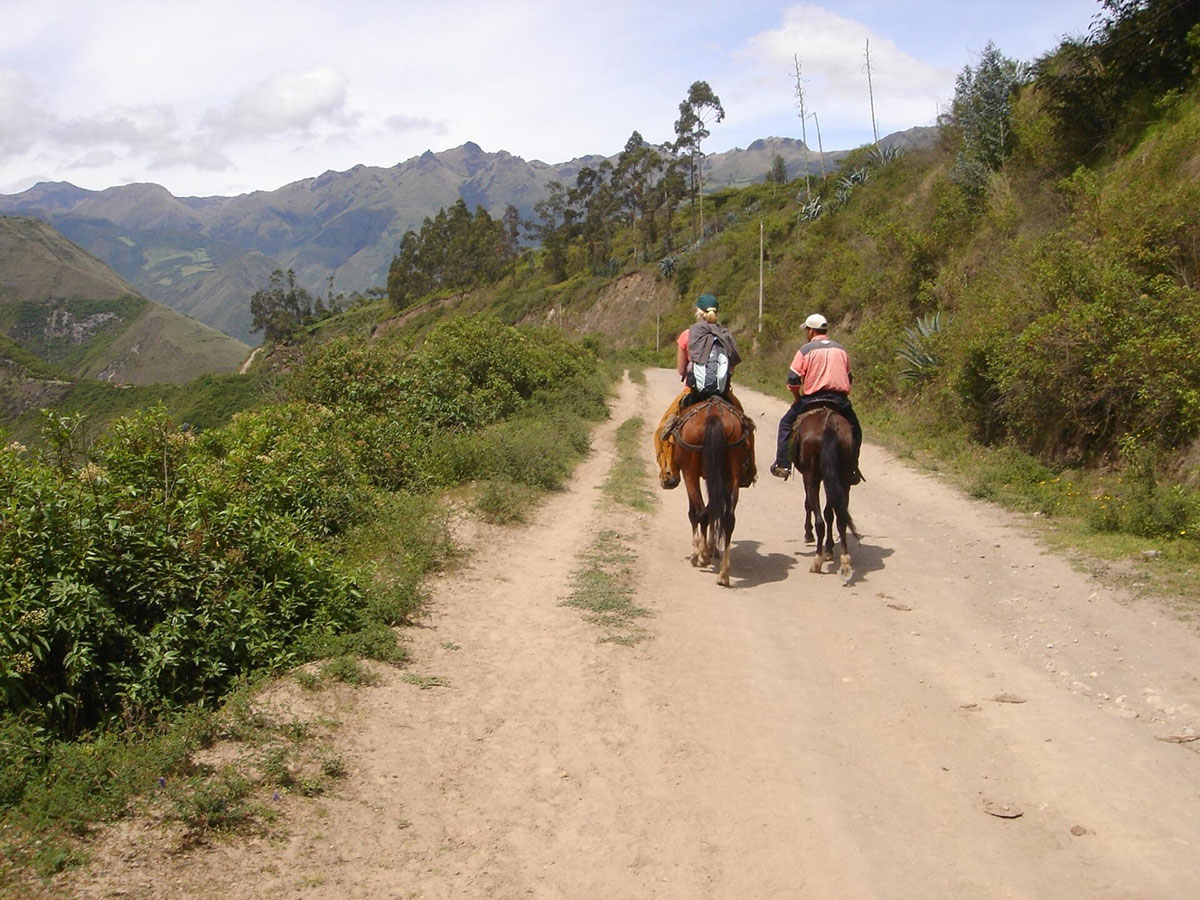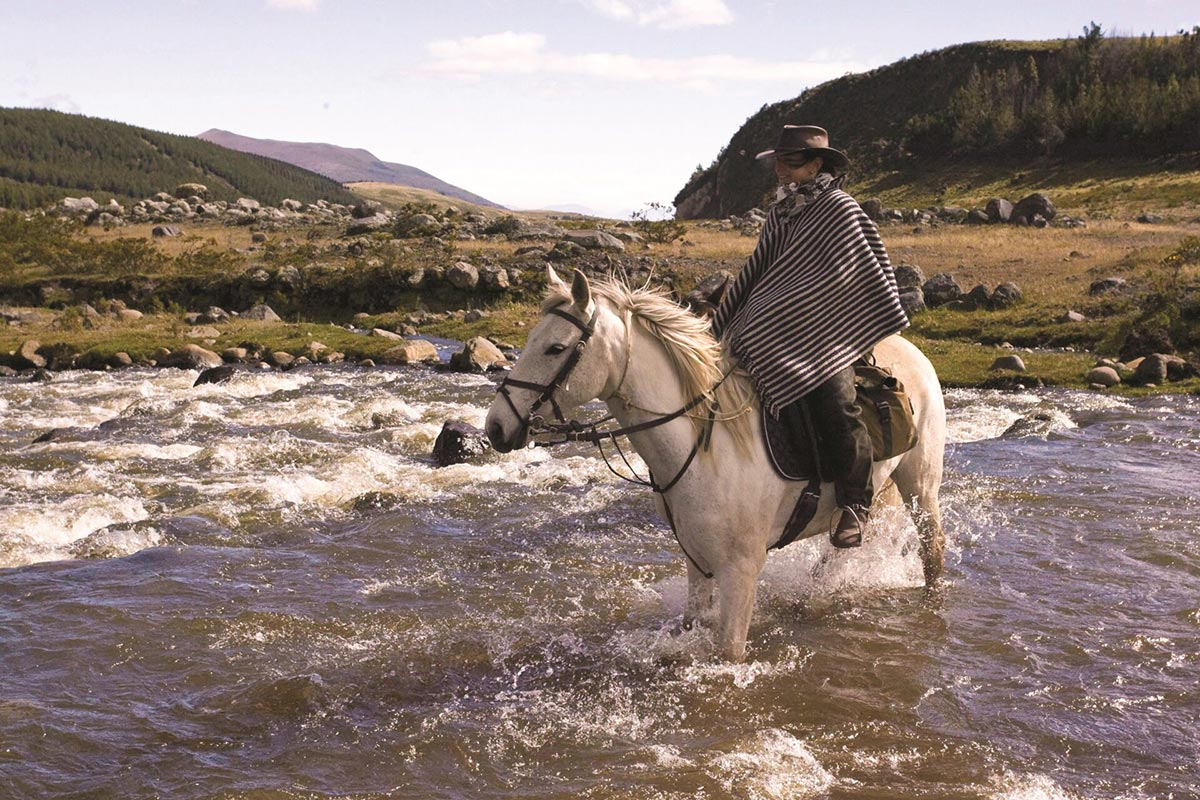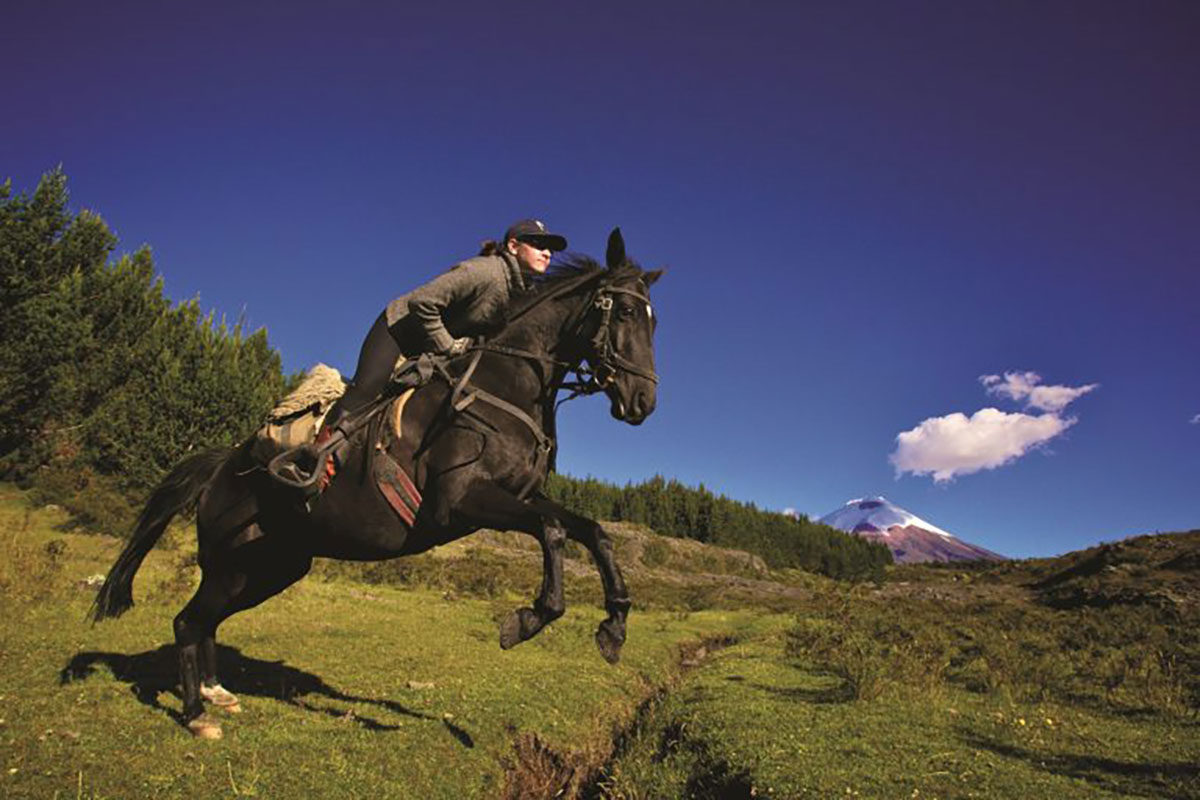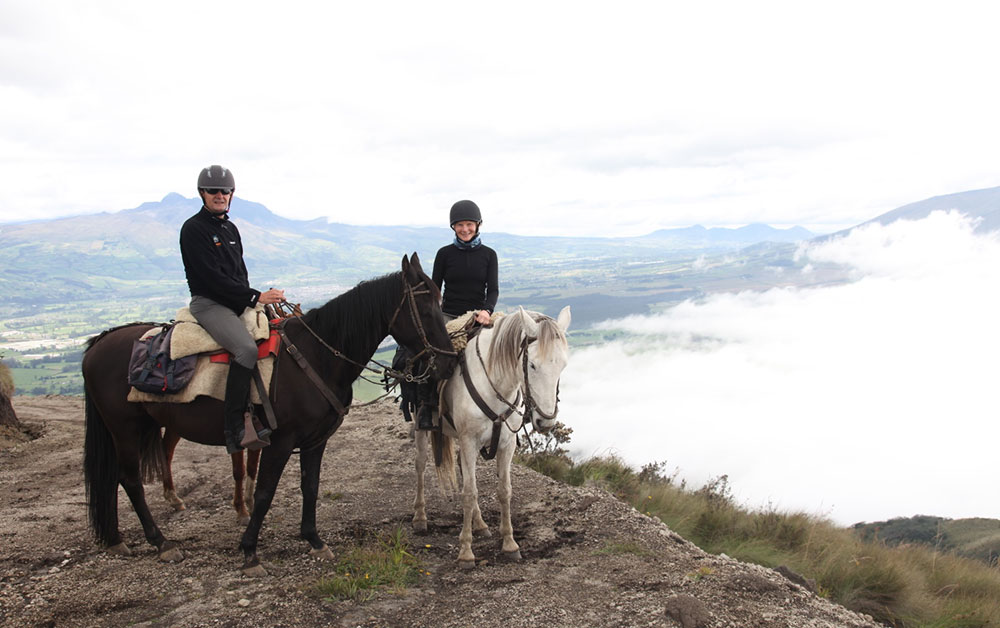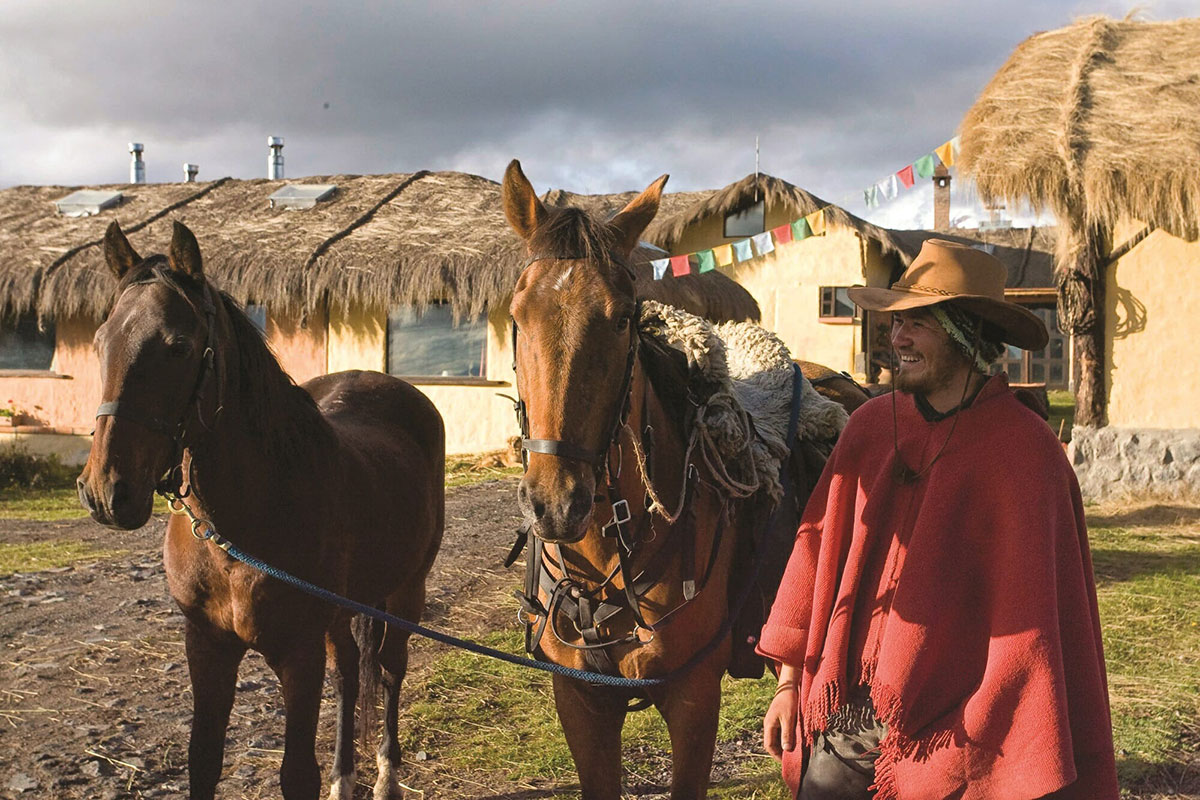
Heading northwards from Quito, after a quick stop on the equator line, we meet the horses and, once everyone is comfortable, head out along the grassy lanes.
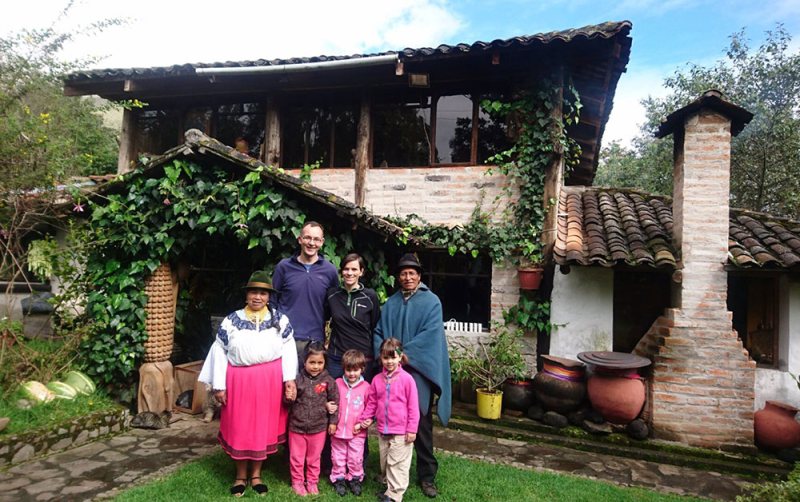
Having admired the magnificent view atop a hill carpeted with wild flowers, we descend to a family run Hacienda in a beautiful pastoral valley. This small working farm with a dairy herd and Andalusian (PRE) horses is the perfect location to leisurely drift into the relaxing Andean atmosphere.
Once settled in at the six-room hacienda, guests can view the collection of Inca and pre-Inca ceramics discovered on site.
Riding time: 2hr drive, 4-5 hours riding
Today, we ride past tiny hamlets of adobe huts, the ladies in their brightly coloured full skirts herding sheep and pigs. We ride through woodlands, and wind our way around the patchwork fields of quinoa, potatoes, maize, lupins and tree tomato orchards.
There are magnificent views of the jagged Mojanda summit as we cross the slopes of the sacred Imbabura volcano — the focus of many pre-Inca legends.
Nearing our stay for the night, a 17th century hacienda, we pass avocadoes, papaya, passion fruit and, riding into the Hacienda courtyard, graced with bougainvillea, the hummingbirds zoom past us enroute to the agapanthus.
A blast of dazzling Andean colour is provided on a visit to the famous Otavalo market.
Riding time: 5-6 hours riding
After a fascinating demonstration by local master weavers and a chance to purchase top quality Andean handicrafts, we ride out of the Hacienda.
Climbing out the valley onto the plains, we pick up the pace and, following agave-lined sandy tracks, ride through a landscape frequently described by guests as the most picturesque they have ever seen. Dramatic views of the hanging valleys and rocky ridges as we descend to lush meadows below passing ladies in traditional dress embroidering intricate blouses as they watch their flocks.
We stop to see the pre-Inca earthworks dotted around this valley -one of the first highland areas settled, also often pausing in awe at the sight of a mighty Andean condor soaring overhead.
Afternoon drive to a very comfortable country hotel located at the trail head of the next part of our ride. Jacuzzi & sauna at this very comfortable lodge.
Riding time: 6 hours horse riding, 2.5hrs drive
First riding along lanes between the meadows, riders get used to their new horses.
Alongside the gurgling river, the abundance of lush vegetation is quite surprising: montane bamboo, ferns and native trees dripping with orchids and bromelias. The birds such as woodpeckers and hummingbirds are wonderful to see, the vultures a little unnerving!
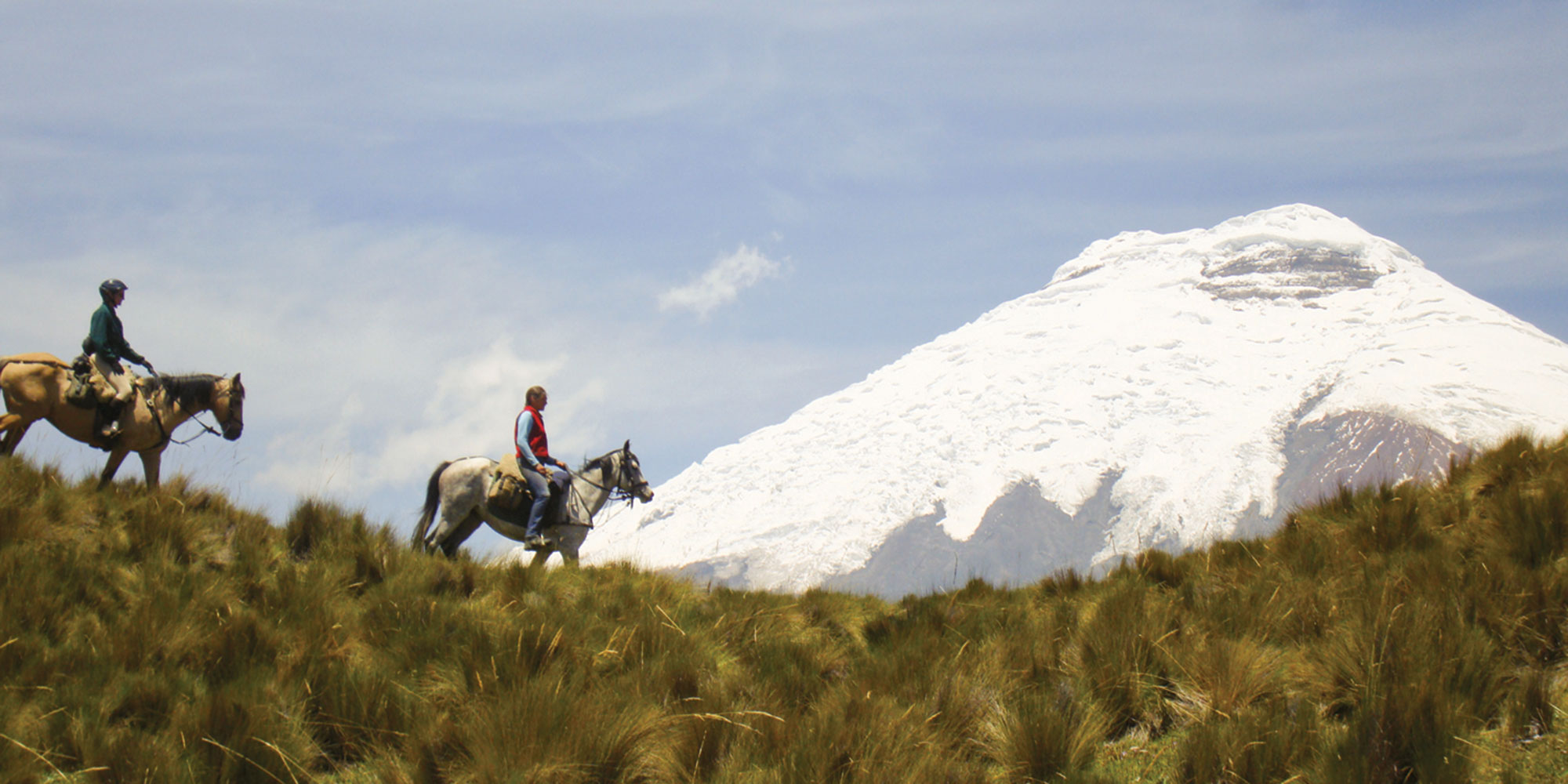
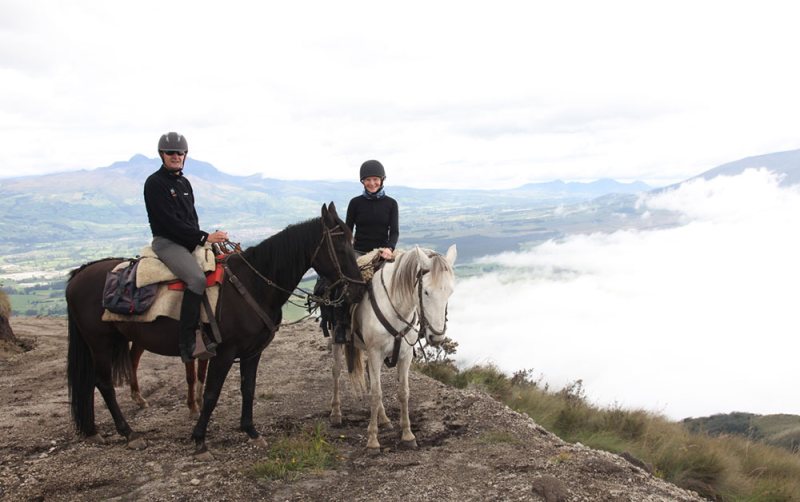
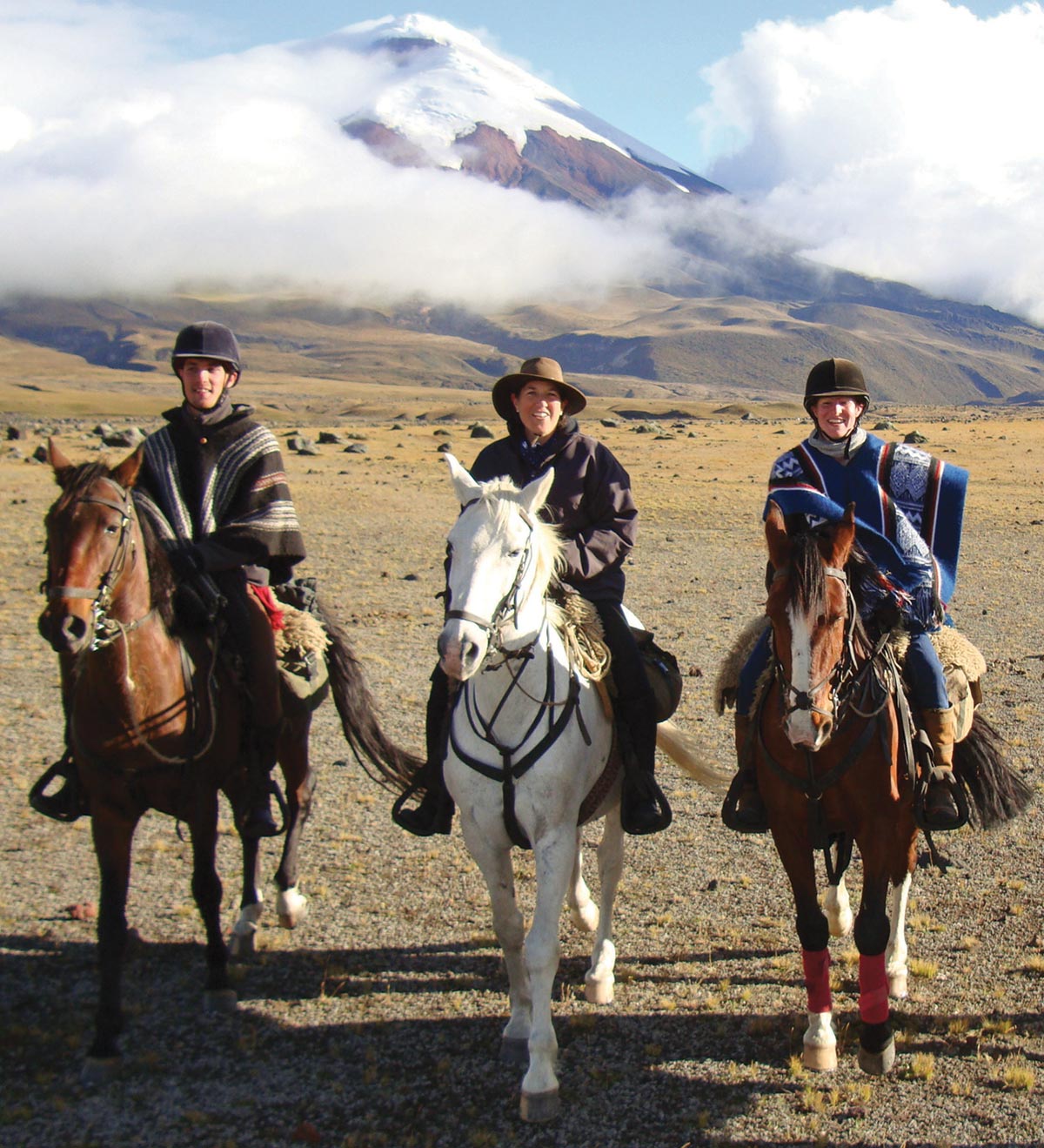
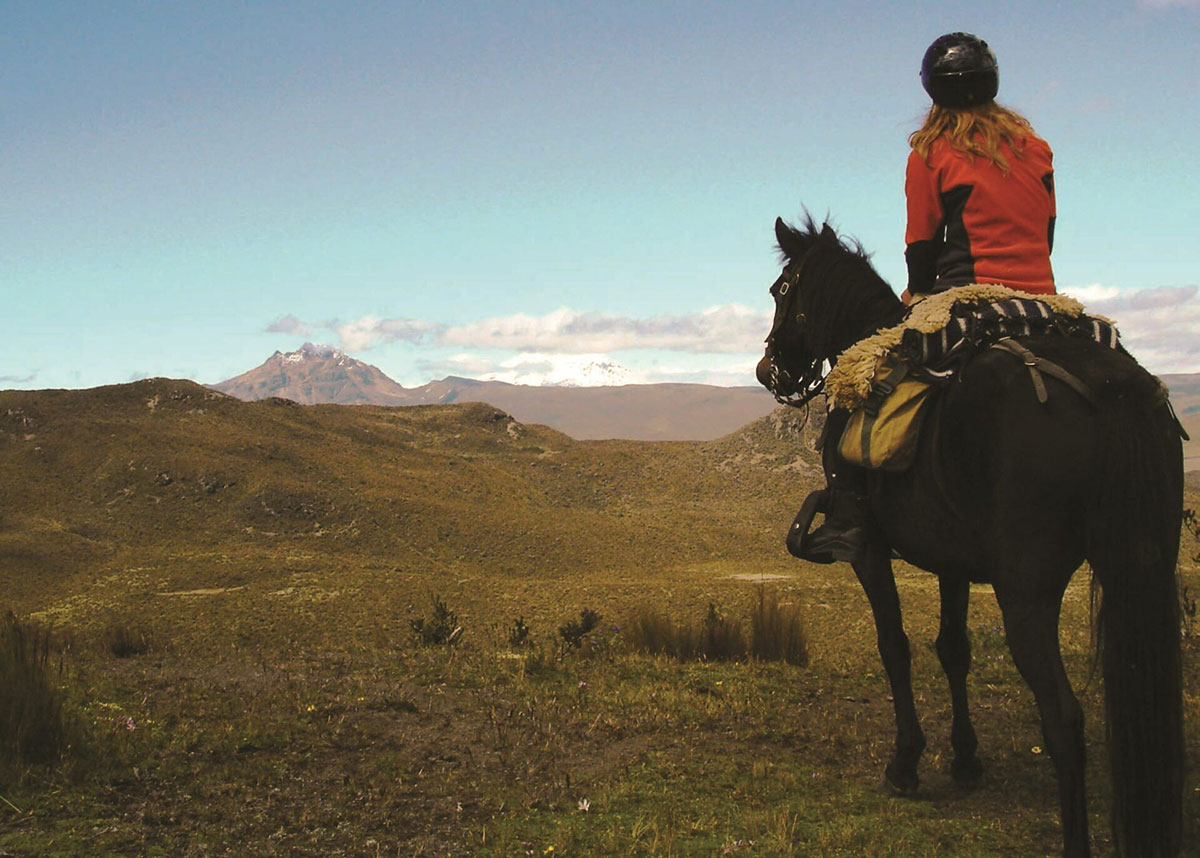
As we leave the micro-climate of the river valley, extensive views open up before us. Surrounded by four Andean peaks, part of the Avenue of Volcanoes, we ride towards the iconic Cotopaxi Volcano.
Riding onto rough grasslands in the Sincholagua foothills there is a good chance of seeing more Andean Condors as well as eagles, hawks, falcons and harriers. At the northern border of the Cotopaxi National Park we arrive at a modern hacienda, often greeted by the llamas.
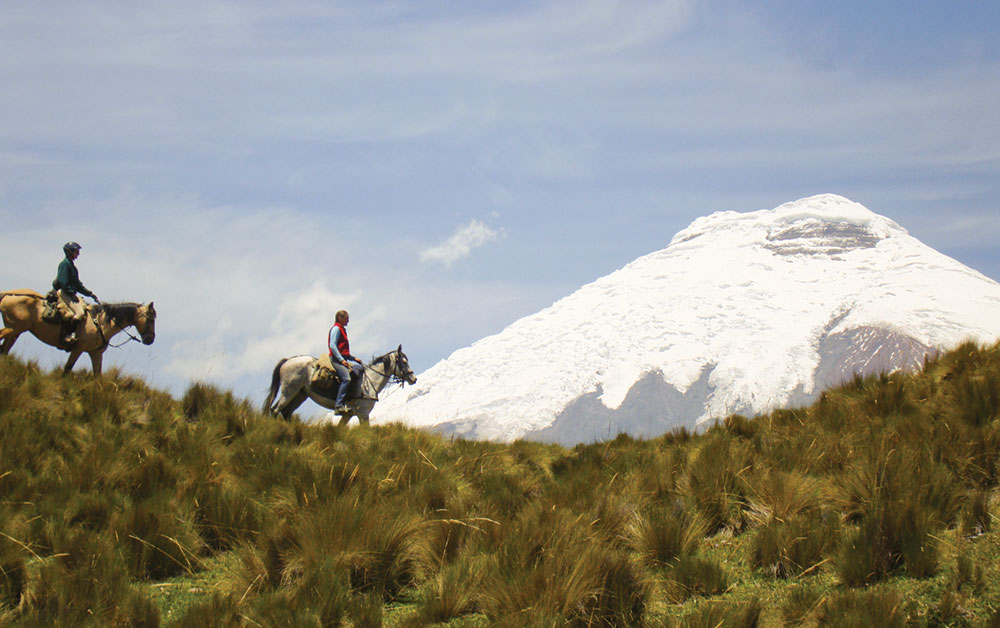
This idyllic location, with remarkable views of the marvellous Andean landscape encircling us, is dominated by the perfectly conical shape of the snow-capped Cotopaxi Volcano. It will be our base for two nights.
Riding time: 6 hours
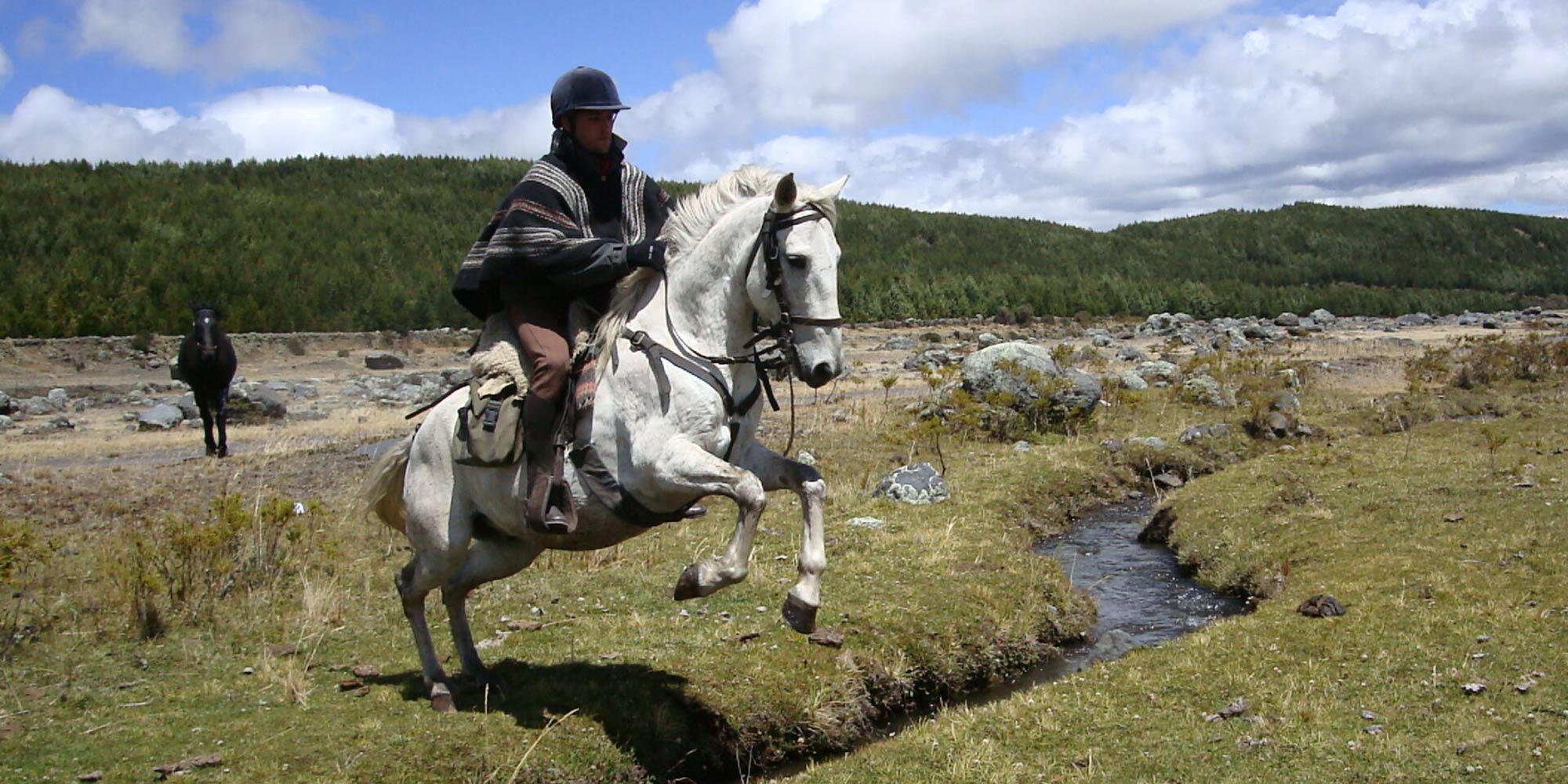
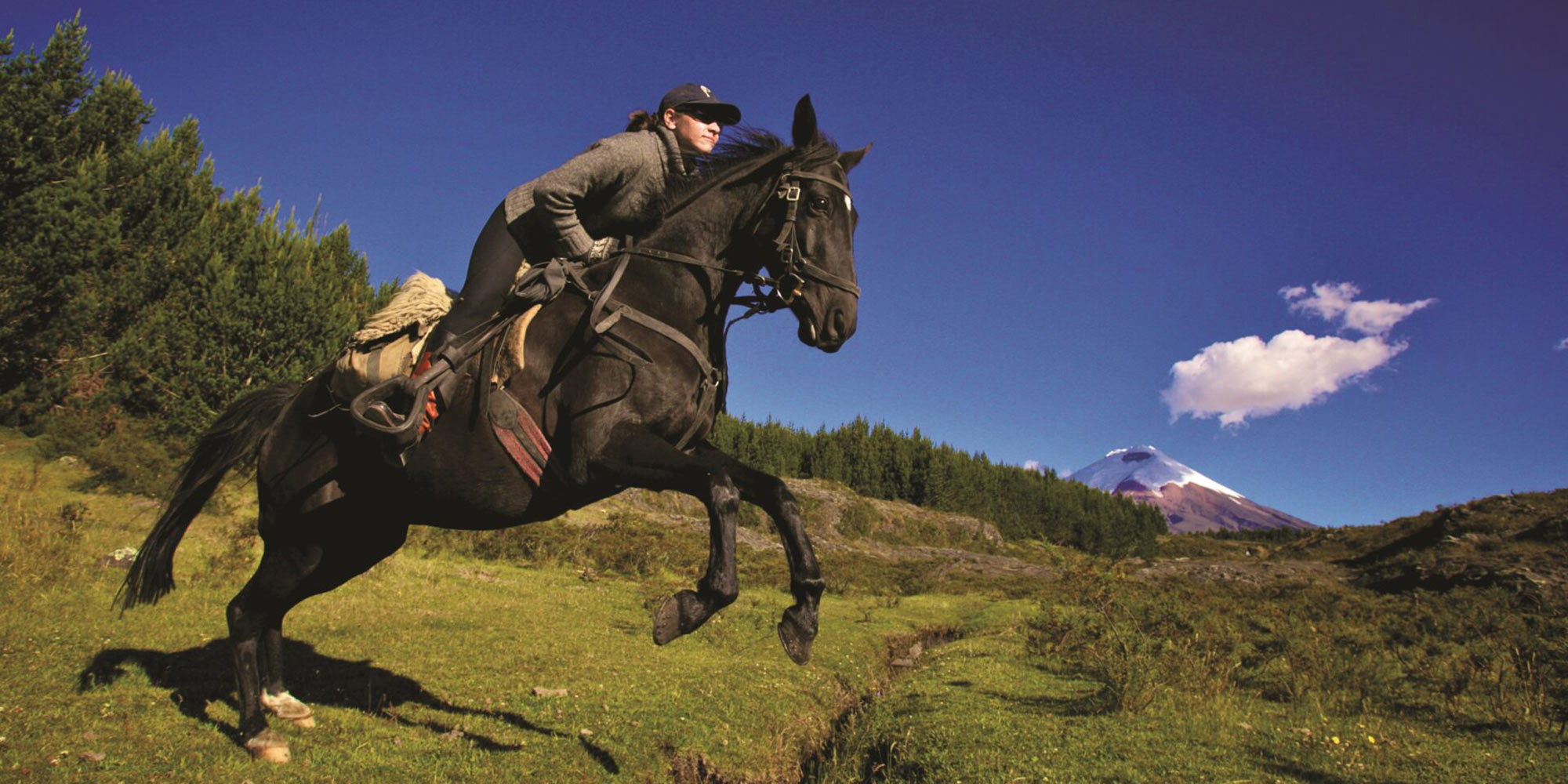
We ride into Cotopaxi National Park on our adorable sure-footed criollo horses for some exhilarating canters across the wide, arid plains at the base of the Cotopaxi volcano. The horses enjoy the open spaces but have such a calm temperament that they settle into a rhythm without trying to rush.
Several herds of wild horses inhabit the park and to ride alongside these long-maned horses galloping freely across the rugged terrain is a unique experience. Part of this ride follows the main Inca highway which linked Quito with Cusco, Peru, then we turn eastwards to follow the Inca route leading down to the Amazon.
We pause to visit the remains of an Inca fort before continuing on through the gently undulating grassy hills, passing drumlins and moraine, crossing lahas and old lava flows before returning to the Hacienda via a canyon. We return to the same hacienda.
Riding time: 6 hours
We head up the slopes of Rumiñahui Volcano (stoneface) with an excellent chance of close encounters with the Andean condor, fox and deer.
We pass polylepis trees (‘paperbark trees’), native shrubs such as chuquiragua and valeriana and a host of colourful wild flowers hugging the hillsides.
Rising above 4,000m/13,132ft and experiencing one of the highest canters in the world, we then ride on into a hidden valley often seeing wild horses grazing close to the towering cliffs. The views are unforgettable and the picnic spot unmatchable.
The trails, marked out by the wild horses, take us back down and on to a once important and now historic Jesuit Hacienda recently restored and now a delightful place to stay.
Riding time: 6-7 hours
The final ride takes us on an exhilarating canter across the flat expanses of Cotopaxi National Park close to the volcano where we traverse old lava, volcanic ash and lahas.
We then veer westwards and start a long ascent with outstanding views. Riding up through the native grasslands in order to reach the scree slopes and cross over into the Avenue of the Volcanoes, we leave the national park.
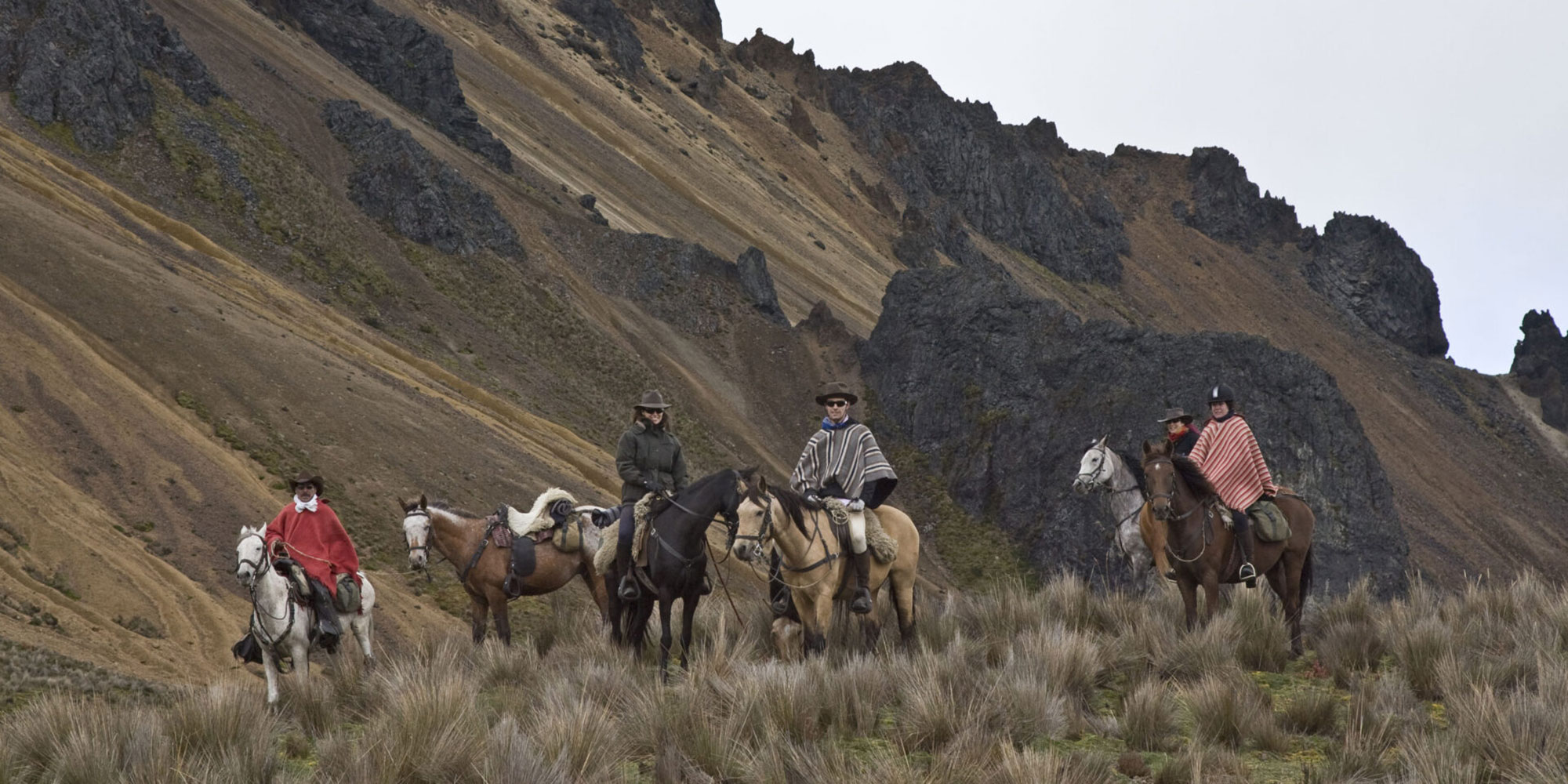
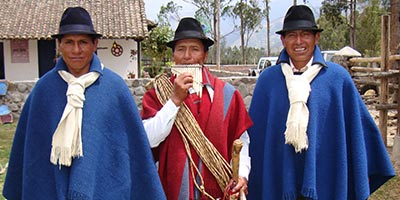
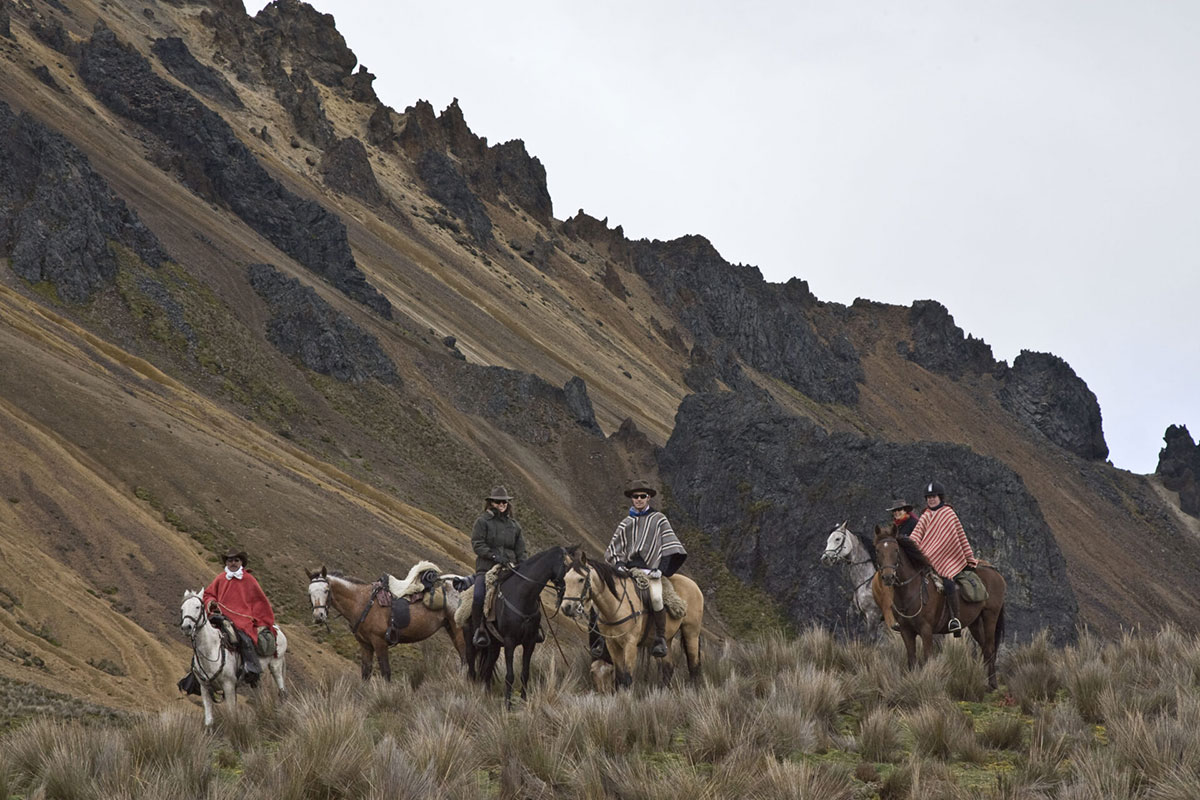
We often meet local horsemen (chagras) checking their cattle, quite a sight, with their colourful ponchos, thick goatskin chaps and intricately plaited bridles. Their stirrups are enclosed, like clogs, and often carved into an animal head. Their lassos seem impossibly long to be useful – but very necessary when working with their very feisty bulls: they lasso the animal then get as far away as possible.
We leave the horses and are driven to a historic hacienda with large gardens, close to Quito airport for dinner and overnight.
Riding time: 6-7 hours, 2hr drive
Following breakfast, guests are accompanied to the airport in time for their outward flights, or we can help with extra tours across Ecuador.
| Departure | Return | Duration (days) | Price from ($) | |
|---|---|---|---|---|
| 23 Dec 2026 | 30 Dec 2026 | 8 | $4800 | Check availability |
Haciendas and hotels, 3* standard with private bathrooms.
Haciendas are often working farms with accommodation.
Riding level for this is intermediate and above, meaning you need to be confident cantering and riding in open spaces, at speed.
Enjoyment from the rides can be greatly increased if you are physically fit and your riding muscles are toned. Guests are welcome to arrive before the start of a set date departure tour in order to do an extra ride with the guide to ‘de-rust’.
You can request instruction if you wish and for private groups can have a riding lesson at the farm on day 1 prior to the riding out or have more formal lessons prior to day 1 (prior notice needed).
We can cater for almost all dietary requirements – please contact us for more.
Whether staying in a hacienda, estancia, hostal or country ranch, the food is excellent, filling and not overly spiced.
Dishes are a mixture of international and local, some meals ‘a la carte’, sometimes set menus.
Delicious tropical fruit such as papaya, mango and custard apple are often on offer in Ecuador as well as hearty highland soups made with prime local ingredients including beans, pulses and vegetables.
If picnic lunches are served, they never consist of just a sandwich – fruits, salads and more where possible.
As well as lunch, variety of snacks and also bottled water all provided each day.
Guests are always accompanied by a guide (bilingual: English/Spanish) who has many years experience of riding.
In addition, at least one ‘groom’ is present – a usually a skilled local horseman.
Both guides and grooms have excellent local knowledge and are good riders. There is also additional ground staff.
Professional guides speaking other languages are available on prior request.
A magical Galapagos cruise blending luxury, wildlife encounters, and local culture amid Ecuador’s awe-inspiring islands.
A seamless Galapagos sailing adventure aboard the Mary Anne, blending luxury, wildlife, and exceptional service throughout.
This horse ride takes us through breathtaking scenery of Ecuador’s Valley of Volcanoes.
Our well-kept horses will be your companions as we travel along ancient Inca Highways and skirt the towering, snow-capped peaks of Cayambe and Cotopaxi.
Overnight stops include lovingly restored centuries old haciendas; no two lodges are alike but all are in exceptional locations and absolutely captivating.
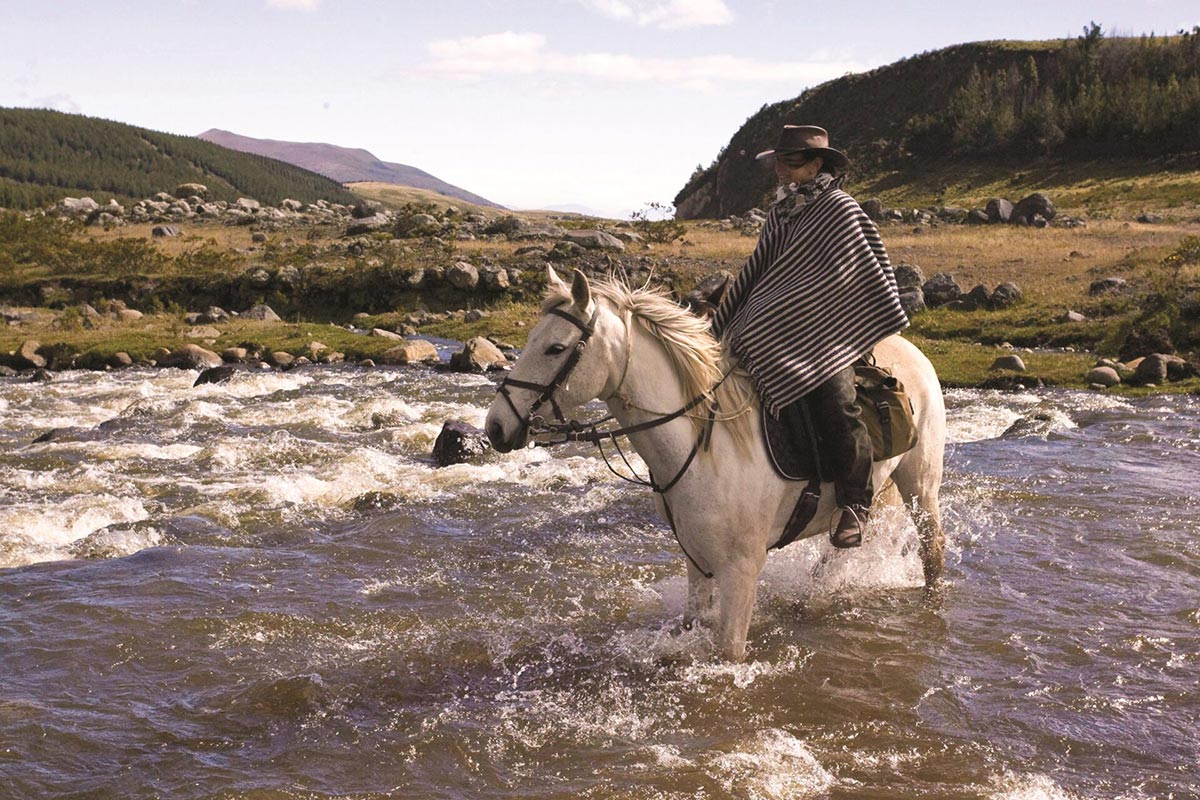
The pace is also varied, from steadily crossing wetlands to cantering across the vast plains of the altiplano.
You can canter through mazes of patchwork fields as we experience the diverse highland landscapes, flora and fauna, and indigenous communities of this fascinating, compact Andean country.
This is horse riding in two stunningly beautiful, yet very distinct areas of the Andean highlands.
Breath-taking views as we cross vast plains and ride through pastoral valleys in a fascinating region dramatically sculptured by both glacial and volcanic activity.
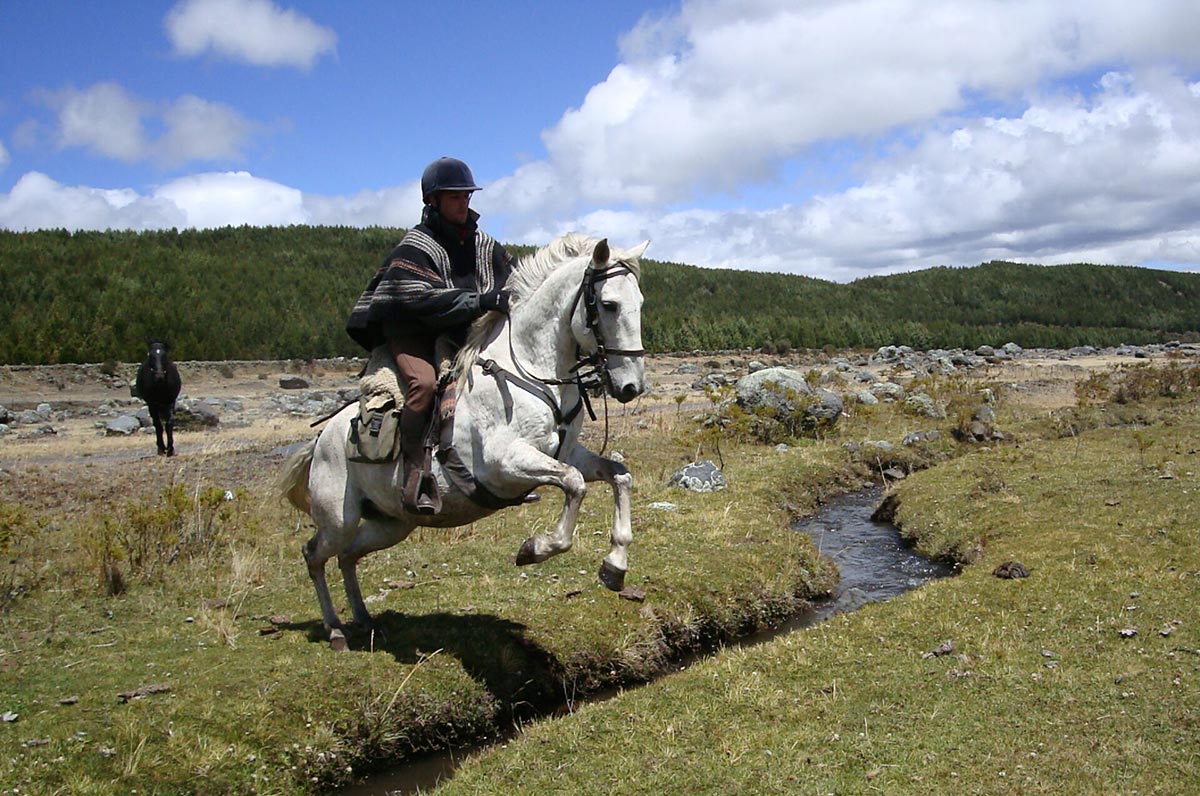
Landscapes vary from the drier south to the more humid north.
The Highlands, or sierra, encompass two Andean Cordilleras (the Central and Western), which run north to south through the country. Ecuador’s largest volcano is Chimborazo (6,310m) whose summit, because of its proximity to the equator, is the closest point on earth to the sun. Several of Ecuador’s volcanoes are still active, and it’s a great area for trekking.
Descending the steep, east-facing slopes of the eastern Cordillera, one passes through a transition zone comprising dense cloud forest and humid high jungle, before entering the Amazon lowlands.
This mainly primary rainforest covers a third of the country, accounts for 5% of the population and stretches across Ecuador, from its Colombian to its Peruvian borders.
The Galapagos Islands are simply unique. Lying 600 miles off the mainland, the archipelago comprises the summits of gigantic equatorial volcanoes.
The flora and fauna of the Galapagos, long separated from their continental cousins, have evolved differently. Charles Darwin used his observations there to develop his theory of Evolution.
Ecuador is the second smallest South American country, and one of the most varied.
It comprises three main geographical areas: the coast, highlands and Amazon plus is home to the Galapagos Islands.
Because of its relatively compact size, it makes a great holiday destination as you can move from highlight to highlight fairly easily and rapidly.
Good kit is vital for every trip.
Book with Andean Trails and get 15% off Páramo’s fantastic ethical and high performance outdoor gear.
Guests are kindly requested on all rides/treks to take a minimum of personal belongings with them. Vehicles bring on guests’ belongings to each nights’ lodgings. Luggage storage can be organised in Quito during the ride/trek.
Please note some trips involve overnights at high altitudes where temperatures sometimes fall below freezing. Please do bring clothing for COLD weather (riding and for evenings).
The rides can be dusty at times and the air is very dry therefore contact lenses can irritate. Guests have experienced problems with contact lenses. We suggest bringing a pair of glasses to replace lenses if necessary.
Guests are strongly advised to bring and use their own riding helmets.
Give plenty of thought to kit selection, and try to keep weight down.
Below is a more detailed kit list.
Riding in the highlands:
Multiple thin layers of clothing are recommended for the changes in temperature. The Ecuadorian Highlands are famous for ‘all four seasons in one day!’
Multiple thin layers of clothing are recommended for the changes in temperature.
Ecuador lies between latitudes 4º south and 2º north. Overall, climate varies according to time of year, altitude and region.
In the Ecuadorian highlands, there is little temperature variation by season as temperature depends largely on altitude.
In Quito, shade temperatures range from 6 to 10ºC in the morning and from 19 to 23ºC in the afternoon, with cool nights. In the lower basins between mountains, it gets significantly warmer.
Rainfall depends on whether an area lies closer to the eastern or western Andes. To the west, June-Sept is the dry period and Oct-May the wet (with often a short, dry spell in Dec or Jan).
The best period to visit Quito and trek and climb volcanoes such as Cotopaxi is the west Andean dry season of June-Sept and Dec/Jan. This is also Ecuador’s high season. During the Oct-May wet season, most rainfall is in the afternoons.
To the east, Oct to Feb are dry and Mar-Sept are wet. Overall, the southern highlands are drier than the northern highlands.
On the Pacific coast, rainfall becomes less from north to south. The coast can be enjoyed year-round, although from June-Sept mornings are often grey with the garua mists.
Jan-May is the hottest and rainiest time of year.
In Ecuador’s Amazonian region, rain can fall at any time, but Dec-March is usually the driest season and Mar-Sept is usually the wettest period.
Galapagos can be visited at any time of year.
The warm season is Jan-Jun, bringing calm, warm waters (around 70°F) and sunny days (72-9°F or 22-32°C), February and March being the hottest and sunniest months with blue skies and sunshine.
The islands receive slightly more rainfall during these months, occasional heavy bursts in the afternoon. Great for snorkelling and you can spend a lot of time in the water without wetsuits, with great, clear waters.
The dry ‘garua’ season is Jun-Dec an it’s a great time for marine life. August and September are the coolest when you may need a jacket in the evenings and the sea can be choppy and temperature drops around 15-24ºC on average.
There can be mist on the islands in the mornings (garua) which usually burns off by midday leaving overcast skies or a sunny afternoon.
Sea temperatures may drop to 60°F- 72°F (15-22°C) during this time and snorkellers will want a wet suit for prolonged periods in the sea.
A magical Galapagos cruise blending luxury, wildlife encounters, and local culture amid Ecuador’s awe-inspiring islands.
A seamless Galapagos sailing adventure aboard the Mary Anne, blending luxury, wildlife, and exceptional service throughout.