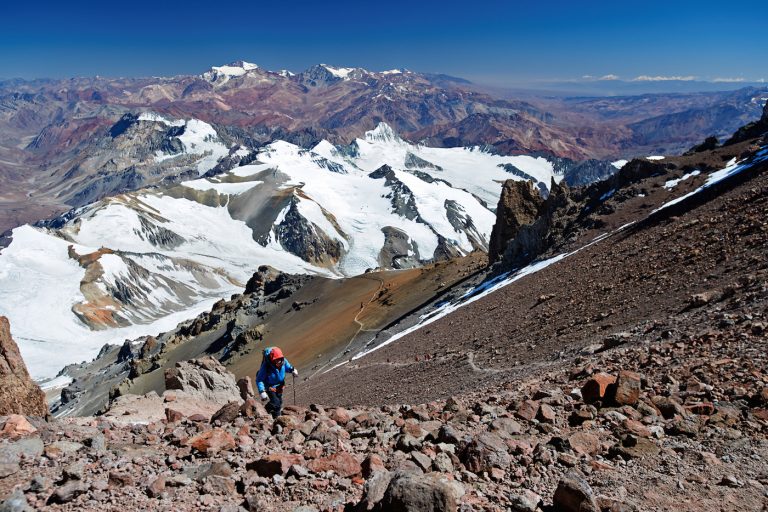
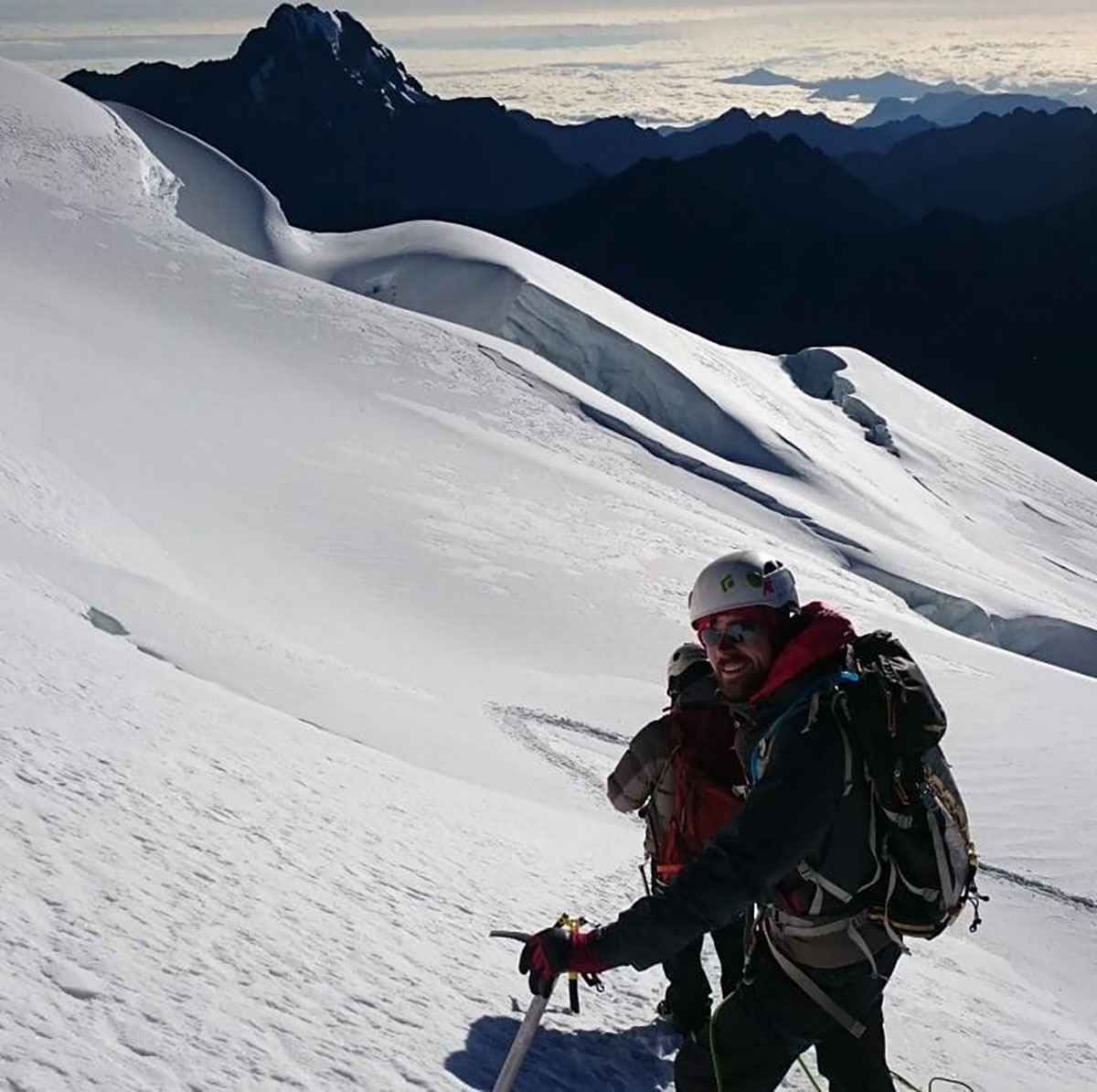
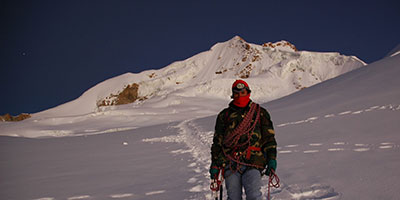
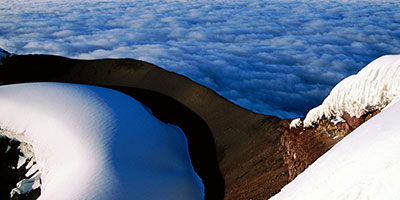
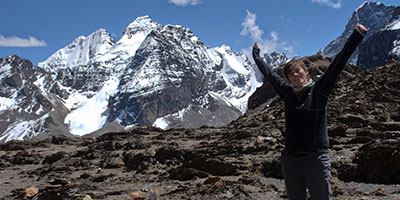
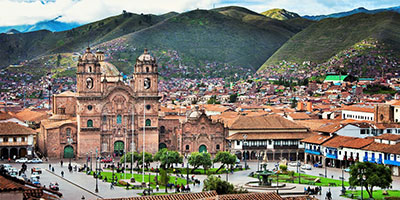
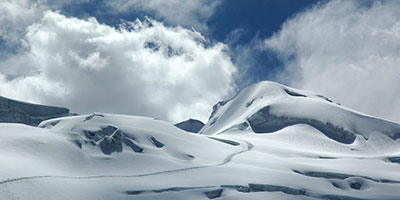
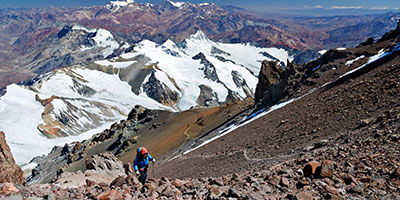
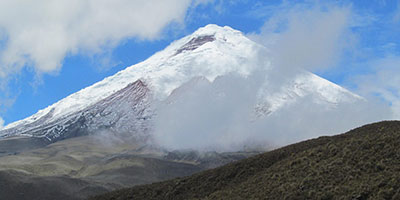
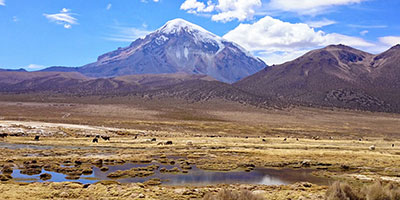
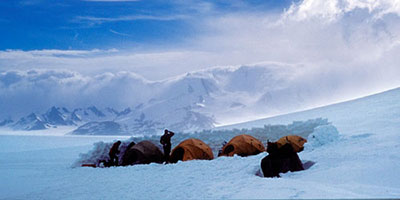
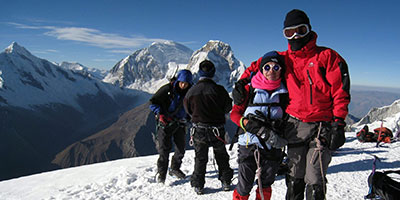
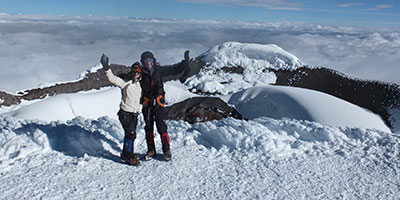
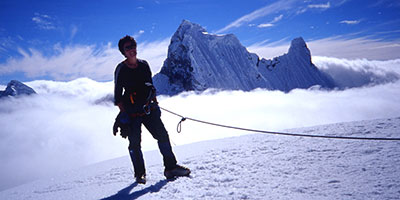
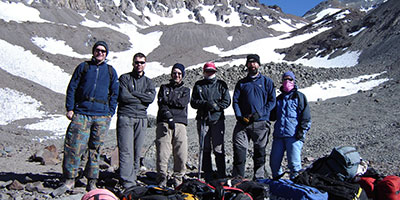
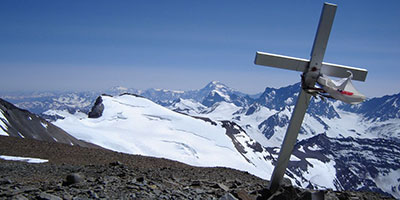
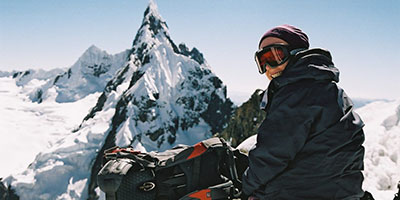
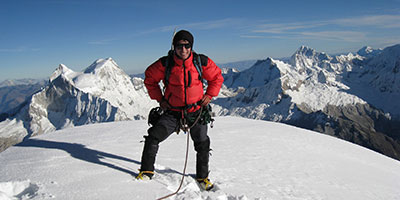
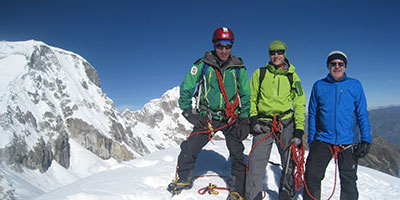
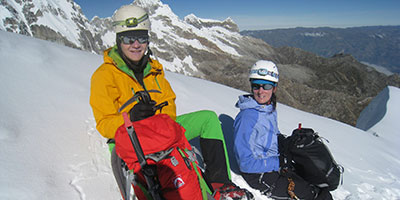
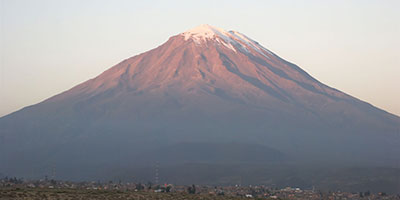
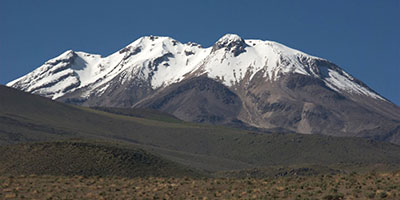
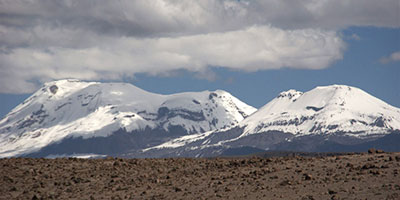
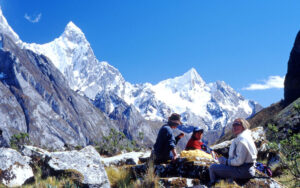
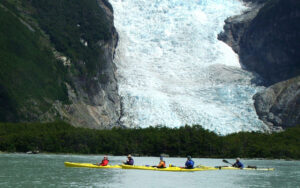
Our professional experienced, UIAGM-qualified local guides will help guide you to the peaks and summits of these impressive ranges, be you a beginner, needing a refresher or an experienced climber.
If you like it high, there are plenty 6,000m/19,685ft+ summits some of which can be hiked, others that are technical ice-climbs and a whole range of peaks in between.
Learn to climb on a mountaineering course or choose a guided mountaineering trip, and if you prefer a less technical experience choose a trekking peak.
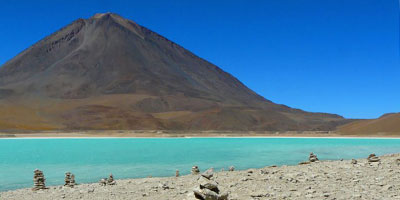
Peru, Ecuador, Bolivia, Chile and Argentina all have great mountain ranges.
Each range has specific seasons for climbing, and some are year-round, so you can enjoy a climbing holiday somewhere in South America at any time.

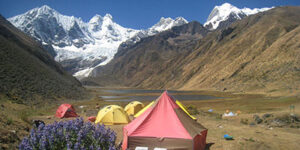
One of our most popular trips is our six day climbing course in the heart of the Cordillera Blanca in Peru, which includes one ascent to get you into the sport.
We also organise courses in Bolivia and Ecuador in preparation for ascents of the Andean peaks there, and of course there is always South America’s highest peak, the mighty Aconcagua.
For the more experienced climber there is Chimborazo in Ecuador, Chopicalqui and Tocllaraju in Peru or Sajama and Illimani in Bolivia, to name a few options.

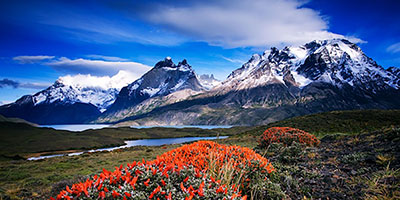
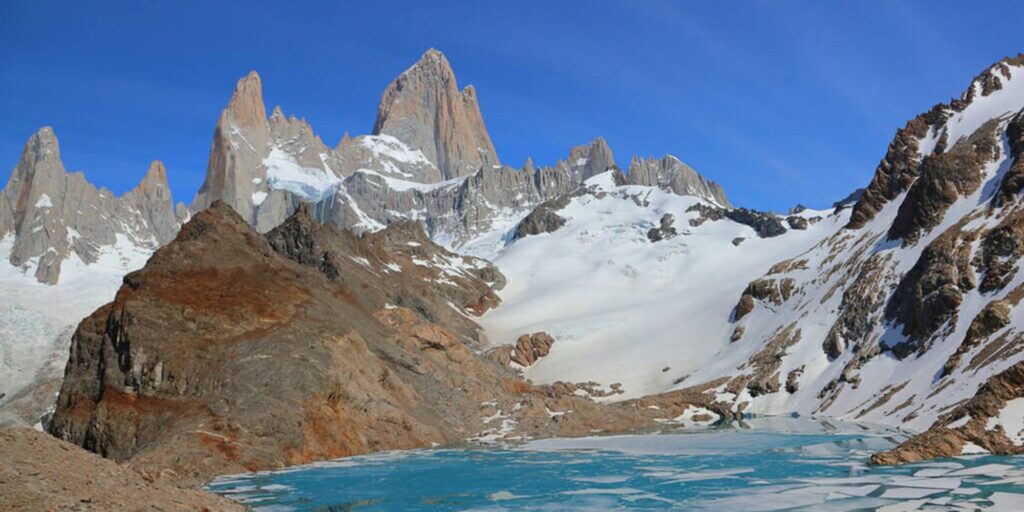
A beautifully organized Patagonian adventure filled with glacier walks, mountain vistas, and smooth, memorable travel experiences.
A thrilling Patagonia adventure combining Ice Cap trekking, luxury lodges, and breathtaking mountain landscapes.
From: $2099 per person
Duration
From: $2730 per person
Duration
From: $1386 per person
Duration
From: $2970 per person
Duration
From: $4450 per person
Duration
From: $1800 per person
Duration
From: $1999 per person
Duration
From: $1939 per person
Duration
From: $3182 per person
Duration
Prepare for your mountaineering holiday.
Below you’ll find a range of travel tips, advice and information that will help you get ready.
If you can’t find what you’re looking for, get in touch and we’ll be happy to help.
You can also read about the weather of Peru in our blog.
Climate depends largely on altitude. As a rule of thumb, below 2,000m climate is mild and above 2,000m warm clothing is required for evenings, nights and early mornings.
The Andean sun is very strong.
Cusco (3,300m): Average max/min temps: 22ºC /2ºC. Average 3 or 4 wet days per month.
Arequipa (2,380m): Average max/min temps: 26ºC /9ºC. Sunny more than 340 days/year with minimal precipitation.
On highland treks: Conditions are generally dry. However, at this time of year, expect a range of conditions within a single day: cold/freezing nights at camps above 4,000m, where pre-dawn temperatures can be -5ºC; warm, spring-like mornings and afternoons; and cold evenings.
Note that mountain weather can be fickle and localised, and that precipitation is not unknown in the dry season. Expect temperatures to swing between sun and shade, sheltered and exposed ground and with altitude gain and loss. A quick-setting sun means temperatures drop fast.
In the cloud forest, e.g. around Machu Picchu, daytime conditions are generally warm or hot, and evenings cool.
Cusco: Average max/min temps: 23ºC /6ºC. Average 13 wet days per month.
Arequipa: Average max/min temps: 25ºC /14ºC.
On highland treks: Wetter conditions, with cooler days and milder nights than dry season. Jan-Mar usually the wettest months.
Good kit is vital for every trip.
Book with Andean Trails and get 15% off Páramo’s fantastic ethical and high performance outdoor gear.
When planning for the extreme climatic conditions encountered on high peaks in the Andes, layering is the most practical and versatile clothing system. It’s worth remembering that our clothing keeps us warm by retaining and isolating the heat we ourselves create.
To best maintain body heat, several layers of lightweight, warm and quick-drying clothing are far more efficient than one or two thick layers.
Layers should have the following qualities:
First (base) layer: This layer wicks the sweat away from our skin, thus helping keep the body dry and warm. To this end, synthetic fabrics such as polypropylene should be used.
Mid layers: These isolating layers should also be synthetic (e.g. the known polar linings such as polartec or windblock, which are light and insulate twice as well as wool). Very important layers for retaining body heat.
Outer layer / shell: Finally, the vital layer which protects us from climatic adversities. A breathable, wind-proof and waterproof anorak, such as Goretex.
Note that it’s our extremities that stand to suffer the most, and on high Andean peaks the poorly-equipped mountaineer is at risk of becoming frostbitten. Hence, much thought should be given to deciding how best to protect hands, feet and head.
Give plenty of thought to kit selection, and try to keep weight down.
Below is a more detailed guide.
For the extreme cold, we recommend a 3-layer scheme:
All other non-personal trekking and camping equipment is provided, e.g. tents, cutlery etc.
These peaks are non-technical and are suitable for acclimatising prior to tackling one of Ecuador’s big volcanoes. We recommend several days in Quito and at least two peaks before doing our mountaineering course or attempting peaks over 5,000m / 16,404ft.
Guagua Pichincha: 4,794m / 15,728ft. An active volcano on the outskirts of Quito that last erupted in October 1999. This is a readily accessible and scenic acclimatisation climb that offers fabulous views from the crater’s rim.
Rumiñahui: 4,634m / 15,203ft. Named after Atahualpa’s general who led the fight against the Spanish conquistadors after Atahualpa was murdered. Legend has it that Rumiñahui hid a large cache of the Inca ruler’s gold in an undisclosed and still unknown location. This climb is a good acclimatisation warm-up in Cotopaxi National Park and offers magnificent views of Cotopaxi.
Imbabura: 4,630m / 15,190ft. The peak overlooking Otavalo. It is a long walk up, with a short scramble near the summit. The summit ridge offers great views of Imbabura’s impressive open crater and Lago San Pablo.
Ilinizas Norte: 5,126m / 16,818ft. An excellent acclimatisation peak with a bit of a scramble to reach the summit and magnificent views. Although it looks like a large pile of rock rubble, the rock is pretty good by Ecuadorian standards.
Pasachoa: 4,199m / 13,776ft. An ancient, severely eroded volcano inactive since the last ice age. It is 30km south of Quito. There is a short scramble from the top of the grassy ridge to the summit.
Carihuayrazo: 5,100m / 16,732ft. An ideal acclimatisation peak in conjunction with the Abraspungo trek. It is also a good place to practise basic glacier skills, use of crampons and ice-axe self-arrest. Loose rock and scree to cross above the glacier and then a scramble to reach the summit.
Cubilche: 3,800m / 12,467ft. Around 14km from Otavalo, a dormant volcano with five small craters on the top. An ideal acclimatisation peak.
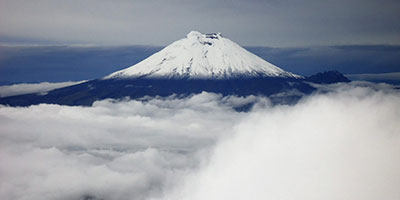
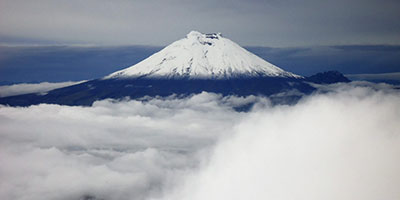
Cotopaxi: 5,897m / 19,347ft. Ecuador’s second-highest peak and one of the highest active volcanoes in the world. It is a nearly perfect snow-capped volcanic cone situated 55 kilometres south of Quito in Cotopaxi National Park. We drive to just below the refuge (4,800m / 15,748ft) and from there it is a 6–8 hour climb to the summit, mostly on steep snow and ice slopes. First climbed in November 1872 by Angel Maria Escobar (Colombia) and Wilhelm Reiss (Germany). Currently active.
Cayambe: 5,790m / 18,996ft. The highest and coldest point on the equator. It is the only place on earth where the latitude is zero degrees and so is the temperature. Long thought extinct, Cayambe is now deemed to be active and is closely monitored.
Chimborazo: 6,310m / 20,702ft. Ecuador’s highest peak and one of the most impressive in all the Andes. Measured from the centre of the earth, it is the highest mountain in the world. Chimborazo is the southern-most peak in the Cordillera Occidental chain. First climbed in 1880 by Jean Antoine and Louis Carrel (Italy) and Edward Whymper (UK). Best time for climbing is during late January and early February.
Antisana: 5,758m / 18,891ft. Big, high and covered in crevasses. Wild and remote, offering some of the most interesting climbing in Ecuador. Climbing Antisana is serious and as technically difficult as Cayambe. This peak has seen relatively few ascents.
Ilinizas Sur: 5,263m / 17,267ft. A technical climb requiring crampons, ice axe, knowledge of self-arrest, glacier travel and crevasse rescue skills. The route is suffering from glacial retreat.

This itinerary takes place within a narrow band of latitudes (32° to 34° south), but covers a very wide range of altitudes.
It also traverses many geographic and climatic zones, from the sun-baked streets of Santiago and Mendoza (both just a few hundred metres above sea level) to Cerro Aconcagua (6,959 metres), on whose upper slopes extreme cold and winds are the norm.
(N.B. All departures coincide with the southern hemisphere summer. Text below refers to this season.)
Temperatures vary greatly between day and night. This is a guideline:
| Zone | Night | Day |
|---|---|---|
| Approach | 0°C | 20 to 30°C |
| Base camp | -10°C | 10 to 20°C |
| High camps | -20°C | -10 to 10°C |
| Extreme temperatures | |
|---|---|
| Minimum | -30°C |
| Maximum | 42°C |
Be aware that Aconcagua is a windy mountain and wind chill should be considered.
Much of this itinerary takes place above 4,000 metres, and extended periods are spent above 5,000m.
Climatic conditions in the Central High Andes of Chile and Argentina usually originate in the Pacific Ocean anticyclone. The humid westerly air currents that it sends inland collide with the Andes and, from time to time, bring severe conditions. Cerro Aconcagua, due to its great altitude and bulk, is especially susceptible, and periodically its upper slopes (above 5,200m) get buffeted by 150kph winds.
Such conditions will often create a vast lenticular cloud above the summit. Even when conditions at Plaza de Mulas camp (4,200m) appear fine and windless, the presence of this cloud formation signifies strong winds, extreme cold and snowstorms high on the mountain. It is also a sign that the upper mountain should be abandoned.
Summer temperatures of -30°C high on Aconcagua are not unusual. Just before dawn at our high camps, in-tent temperatures commonly reach -15°C to -20°C, and near the summit, wind chill can lower temperatures to -40°C.
Very high up on Aconcagua, temperatures never get very high. Even at base camp (4,200m), rare southerly winds sometimes bring temperatures of -18°C. Severe electrical storms are another occasional summer phenomenon and should not be underestimated.
Nevertheless, summer days and nights on Aconcagua can also be relatively tame. On still days at noon, it might be possible to spend time at base camp in a bathing suit. On particularly benign, windless days, it is sometimes feasible to stand on Aconcagua’s summit at noon wearing only a few layers.
The fickle, and often localised, nature of Aconcagua’s climate means nothing should be taken for granted. Frostbite and hypothermia are risks for the under-equipped mountaineer, so it is important to pack for the worst conditions.
On the lower slopes of Aconcagua, conditions are less extreme and unpredictable, but still prone to rapid changes. Below 4,200m, afternoons are generally warm with plenty of sunshine. The sun is extremely strong and burns very quickly.
At lower camps on Aconcagua (around 3,300m) days are warm to hot and nights cool to cold. At base camp (around 4,200m) expect warm days and freezing nights. At altitude, temperatures vary sharply between sun and shade, sheltered and exposed ground, and with height gain and loss.
Being at altitude, especially in the tropics, is usually a pleasure as it isn’t so hot, there are few insects and the air is clear.
However, when gaining altitude, air pressure drops and the amount of oxygen reaching the lungs is reduced. Although we build plenty of acclimatisation time into our itineraries, certain ill-effects are possible. Nevertheless, all of these can be minimised or prevented if care is taken.
On reaching heights above 2,500m (approx. 8,200 ft), especially when ascent has been straight from sea level, heart pounding, mild headache and shortness of breath are normal, especially on exertion.
Acute mountain sickness (AMS) is a syndrome known locally as soroche, whose symptoms can include of bad headache, dizziness and nausea).
To avoid AMS, you should: