I got into travel because I love being outdoors, and I love putting other people’s trips together and then travelling with them, vicariously.
Somewhere along the way, over the past decade, I have started believing that tourism, done properly, can be one of the best enablers to protect a place. If a patch of Amazon is worth more to a community with people in it, walking through it, paying to see it, than it is cut down and turned into something else, then tourism isn’t a threat to that forest. It’s one of the things keeping it there.
I wanted to test the theory against something real, so I went to Tambopata and visited three lodges, each one deeper into the reserve: Posada Amazonas, a brief stop at Refugio Amazonas, and finally the Tambopata Research Center, right inside the protected area itself. I went in curious. I came out more convinced than I expected, with one significant exception. Here’s the account, and here’s where I landed.
Into the Forest
My flight from Lima crossed the Andes and dropped me in Puerto Maldonado, where my guides were waiting with my name on a sign and an air-conditioned bus for the drive out of town. The road out passed through banana plantations first, and the forest started to close in as we reached the Tambopata River.
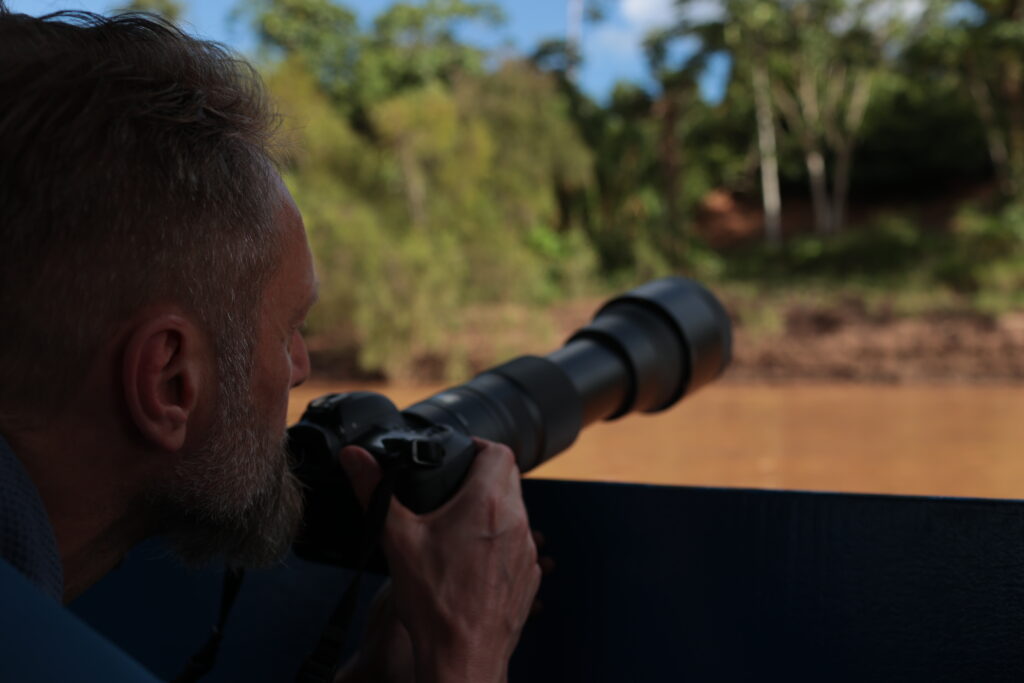
From the moment we were on the boat, we were straight into thick, proper Amazon forest on both banks—denser and closer with little evidence of roads or civilisation.
We spent that first afternoon just trundling downriver, watching and staying alert. A small group of capybaras grazed on the bank, entirely unbothered by us. Butterflies gathered in clustered clouds on patches of clay, then lifted off together, which had an odd, almost cartoonish beauty to it. Lunch was rice with plantain and a cheese mixture wrapped in banana leaf, served in a woven basket that defeated at least two of the men on my boat, who dropped theirs on the deck.
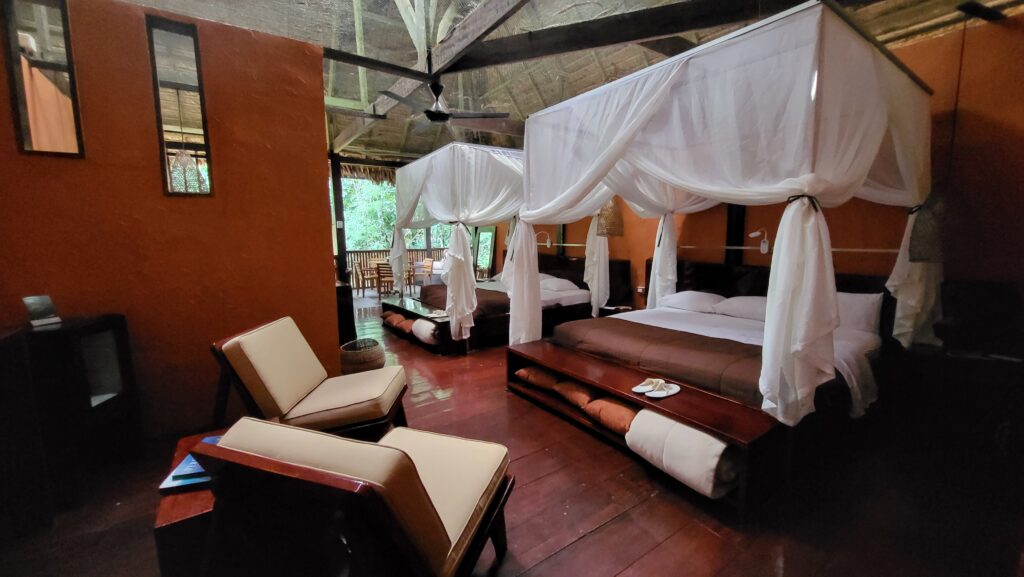
Posada Amazonas, the first lodge, featured rooms open on every side: no walls, no windows, just mosquito netting between me and the forest. It felt like extremely comfortable camping: a huge veranda looking straight into a wall of trees, a hammock where I could lie and watch the canopy, and, that first night, an outdoor bath in the pitch dark listening to insects rather than the monkeys and birds that took over during the day.
The Small Things, Not the Big Things
Everyone arrives in the Amazon hoping for the big mammals—jaguar, tapir, something dramatic crashing through the undergrowth.
The forest near where I live has bluebells and beech trees and it’s lovely, but this is a whole other level of biodiversity. The Amazon simply has an incredible volume of life stacked on top of itself, in every direction, at every scale from canopy to leaf litter.
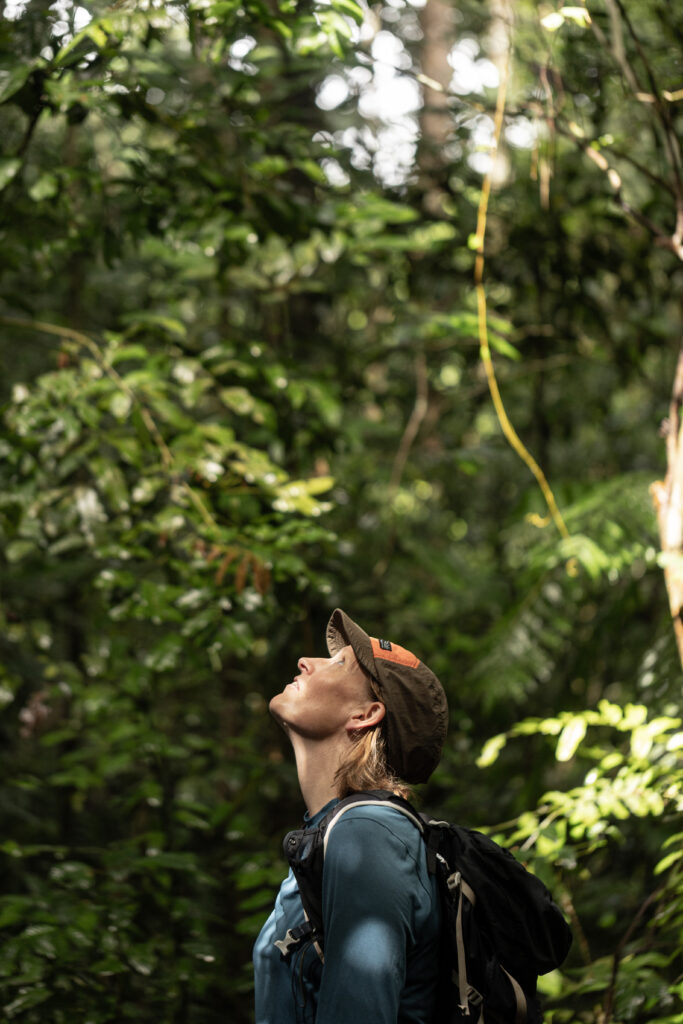
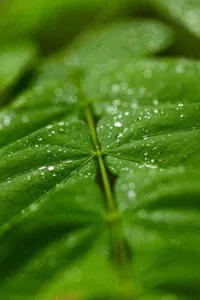
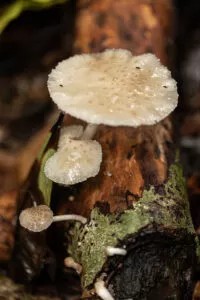
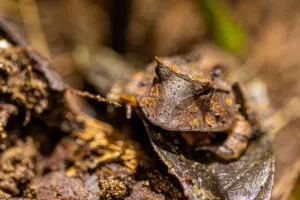
What fascinated me, walking through the forest with my guides Juan Carlos and Jair in my wellies one rain-soaked morning, was the sheer density of small things: a horned frog that looked almost ordinary until a photographer’s macro lens revealed something closer to a small dragon. Next, a tortoise ambling across the path; then two vines wound around each other in a perfect corkscrew; and next, moss and satellite-dish fungi on the roots of walking palms.
That’s the thing I didn’t expect going in: the feeling wasn’t really about seeing a headline species. It was about standing in something that dense and that alive and wanting, quite badly, for it to still be there in fifty years.
Citizen Science: I Went in Sceptical
There are five conservation projects in progress across the three lodges and, every evening at each lodge, a guide gave a lecture a project. One night focused on the moth-trapping programme that’s been running for years and has turned up new species simply by keeping a light trap going and counting what shows up.
Another night, at Tambopata Research Center, covered an acoustic monitoring project that records primate calls and forest sound more broadly, building a reference library detailed enough for researchers to tell which monkey species is making which call in which situation. My question: what’s the actual point of tourists who aren’t scientists tagging along on this?
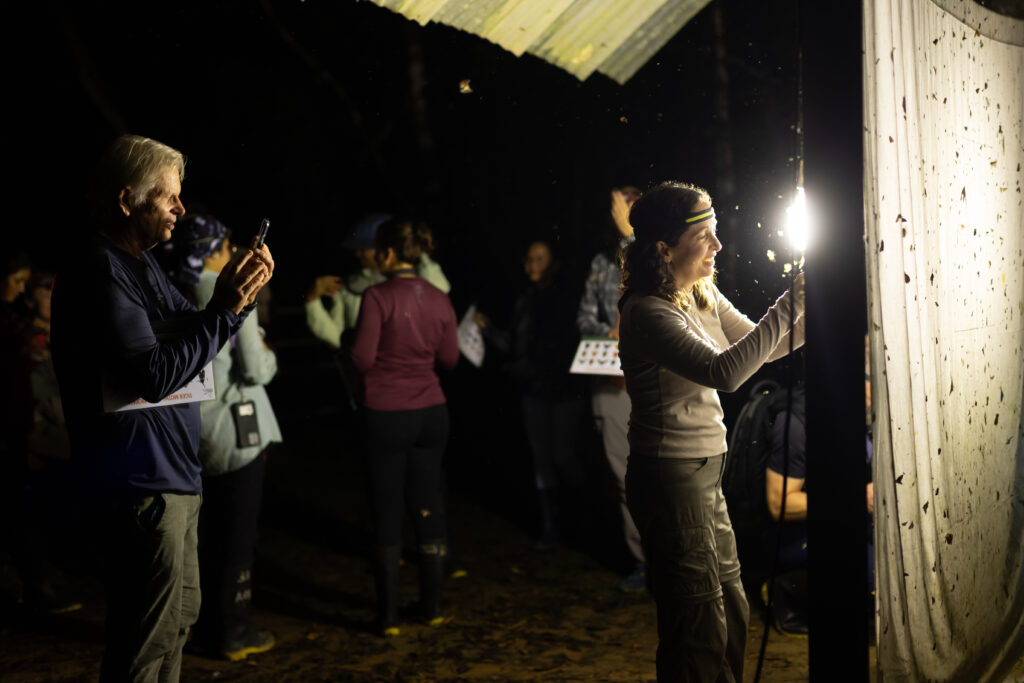
Having watched it happen, I understand the logic better. The researchers would do this work with or without guests. But guest involvement helps fund and sustain it, keeping interest and money flowing toward monitoring that would otherwise remain invisible. Crucially, the data can be used to hold others to account.
The acoustic and camera-trap monitoring isn’t just a nice guest activity. It lets the research centre put a number on the impact of the illegal gold mining happening near the reserve and take that evidence to whoever needs to see it. That’s genuinely different from performative “conservation tourism”, and it’s a measurement that could theoretically hold someone accountable.
What I Actually Saw of the Community
Posada Amazonas is part-owned by the Native Community of Infierno, an Ese’Eja community, in partnership with Rainforest Expeditions. This joint venture has been running for years and is often held up as a model of its kind. At first, I found myself thinking that I hadn’t had some big, obvious “community encounter”.
Then I learnt that around 80% of the staff at the lodge are from the local community, which meant I had been meeting people from the community constantly: when I was checking in, eating meals, asking questions, going out on walks, without apparently noticing that this was what community involvement actually looked like.
Other details also added to the sense of community involvement. There are hand-woven fans by every bed, made locally. I bought a small carved woodpecker from the handicraft stand, made by someone from the community. The Brazil nuts on the table at every meal are harvested locally and providing a real income source because they give people a reason to keep the forest standing rather than clear it. Local guides, Juan Carlos among them, had grown up in this forest, and knew it in a way that no amount of training elsewhere could replicate.
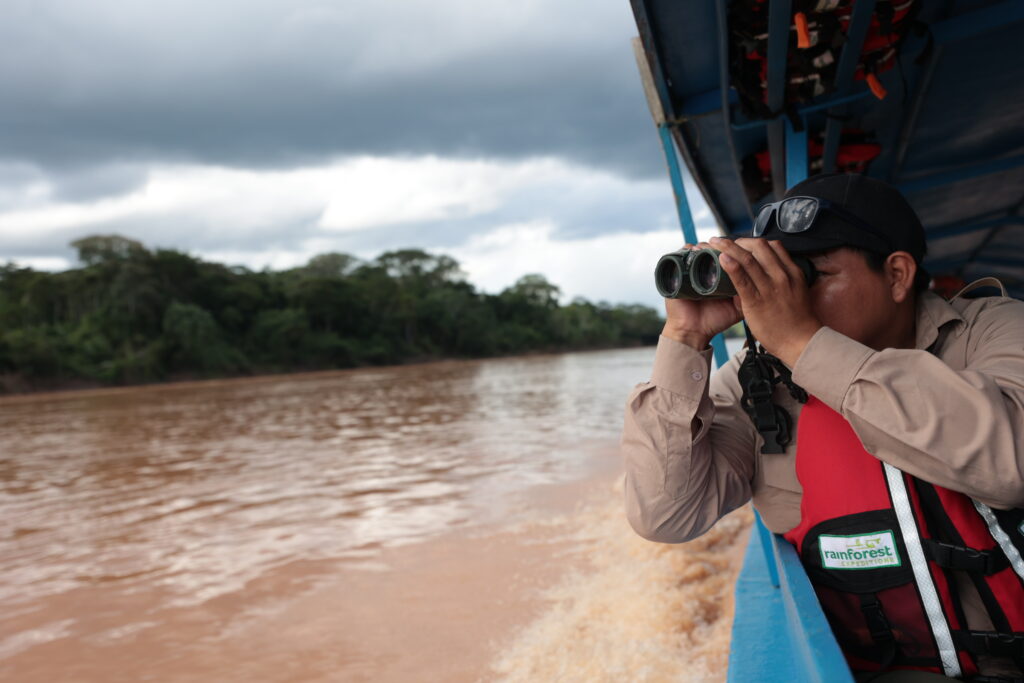
So the ownership and the income are real and traceable, and I could see the mechanism by which tourism money reaches people who live here. But what made it feel richer to me was precisely that it wasn’t packaged as a costume-and-dance “community experience”.
I have felt uncomfortable with that in other community projects, where culture can start to feel as though it has been arranged into a neat performance for visitors. Here, the community underpinned everything: the staff, the food, the objects, the guiding, and the ownership structure. It felt less like being shown a version of someone’s identity, and more like seeing how tourism was woven into everyday life.
The Most Memorable Moments
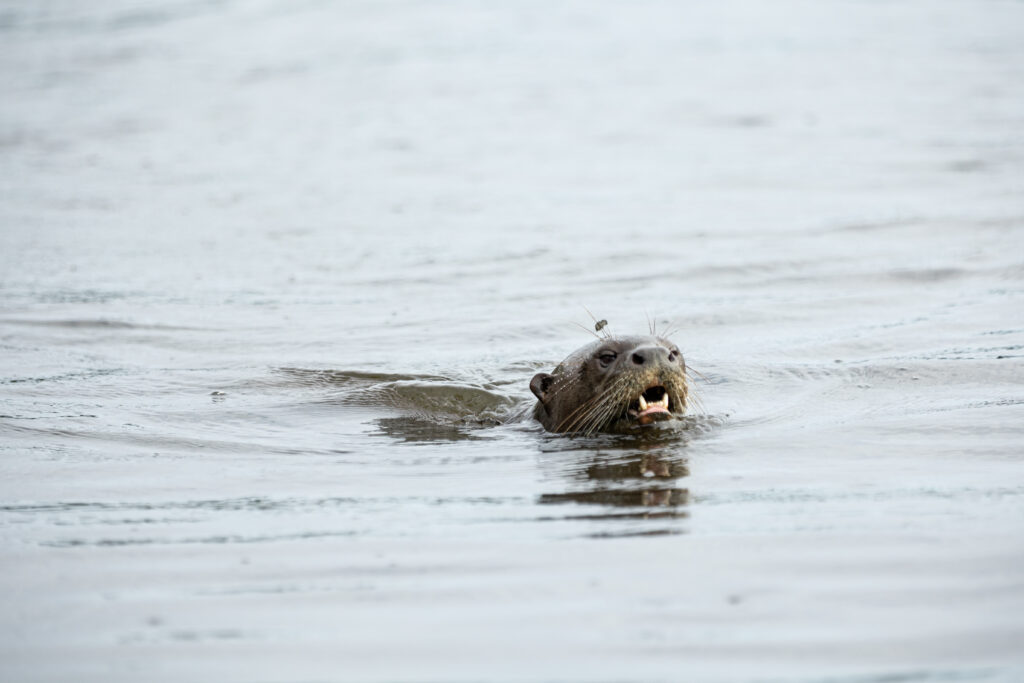
Two moments stood out above everything else. The first was an early start on an oxbow lake, moving in silence except for my guide paddling like a crocodile’s tail through still water. Suddenly, a family of giant otters came right over to investigate us; they continued diving for fish, surfacing to eat, while showing genuine curiosity about our boat before a second boat arrived and stole their attention.
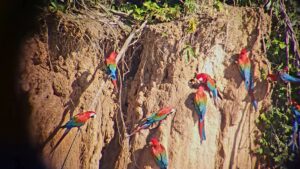
The second moment was when I visited the clay lick near Tambopata Research Center, a proper performance, staged by nature rather than for me, but no less dramatic for it. Parrots arrived first, gathering in the highest branches, testing whether it was safe. Then more came, and they gradually moved lower in the branches, covering each other and keeping lookout, until they eventually visited the clay lick and ate clay, replenishing sodium and reversing the toxicity of the plants they had eaten.
Macaws followed, red and blue and green against grey clay, with a hawk occasionally scattering the whole scene and sending everything back up into the canopy. Watching it build over two hours felt like being at the ballet with all the dances building to the finale. It was tense and beautiful and clearly dangerous for the birds: big cats will wait at the base of the clay lick for exactly this reason.
Back at the lodge that night, we learnt about an inspiring conservation effort that began decades ago. A drop in macaw numbers had been associated with a decline in shihuahuaco trees, huge old trees that macaws naturally nest in. These trees can take 400 years to reach maturity, and the macaws couldn’t wait that long. So artificial macaw nests, built by hand from cylindrical materials, were designed to mimic the trees.
Amazingly, this intervention actually worked, and the macaw decline was no longer so desperate. The coolest thing is that you can watch the macawcam when you go home and keep tabs on what the macaws in their nest box are up to.
So what do I think now?
I went to Tambopata wanting to know whether the community-and-conservation story was real, or marketing dressed up in banana leaves and ice-cold welcome towels (which I was very grateful for).
My honest answer, having seen it: mostly real. The ownership structure at Posada Amazonas gives the local community a genuine financial stake in the forest staying intact. The Brazil nut harvest and artisan sales are tangible, visible income. Local employment at the lodges is evident, even if guides also come from further afield.
And the citizen science, which I expected to dismiss as a nice-to-have, turns out to generate the evidence base that lets researchers actually document what’s happening to this forest. The lectures were interesting and inspiring, and I came away wanting to know more and keep in touch with the projects: I am a long-term ambassador now.
I came away more hopeful than I expected. The conservation projects made me feel like someone was watching out—the sea of trees and the intense immersion in biodiversity filled me with hope and revitalised me.